Deliberative conversation · Phase 1 · November 2024
The Public Participation Bill 2024
“How can we improve public participation in Kenya?” zKe gathered young people’s views on the bill online, on air and in barazas, and sent their recommendations to the Office of the Attorney General.
WhenNovember 2024
Wherepol.is, TikTok Live, Spice FM, WhatsApp and youth barazas
OutcomeMemorandum to the Attorney General
At a glance
The most voted-on Phase 1 conversation
502
people took part on pol.is
15,428
votes cast
98
statements written by participants
48%
of those who answered said they are Gen Z (214 of 448)
Source: pol.is, conversation 6bmejxaanc.
Background
What the bill proposed
The Public Participation Bill, 2024, sets out a framework for how public engagement in governance is run, with standard procedures and clear guidelines. It proposes an Office of the Registrar of Public Participation to oversee participation, make it inclusive and receive and process the public’s input. The Office of the Attorney General invited proposals on the bill, and the submission deadline was 15 November 2024.
A registrar
An Office of the Registrar of Public Participation to oversee and standardise engagement.
Participation plans
Detailed participation plans and stakeholder analyses to guide public input.
Inclusion and transparency
Mechanisms to make public participation inclusive and transparent.
Using public views
Clear guidelines for receiving, processing and using public views in decisions and laws.
What young people agreed on
Open the doors of Parliament
These five statements had the highest group-informed consensus. Nearly everyone who voted agreed, in all four opinion groups.
The most agreed statements, in participants’ own words
“Use various media platforms, especially radio and mobile technology which are widely accessible, to educate citizens about their rights to participate and how they can do so. This isn’t just information dissemination; it’s an invitation for citizens to be co-authors of their country’s future.”
99% agreed · 0% disagreed · 207 people voted
“Develop user-friendly digital platforms where citizens can view bills, provide feedback, and even engage in live discussions or Q&A sessions with bill authors or committee members. This could feel like opening the doors of Parliament to every Kenyan home, making the legislative process a shared journey.”
97% agreed · 1% disagreed · 205 people voted
“After legislation, release reports detailing how public input was used or why it wasn’t. This accountability can feel like a dialogue rather than a monologue, showing citizens their contributions are valued.”
98% agreed · 0% disagreed · 201 people voted
“Public Participation must be available for all. Minimum 30 days for submissions at every constituency.”
97% agreed · 1% disagreed · 194 people voted
“The bill should have a feedback mechanism where the public is informed, in whichever way, why certain proposals were not accepted.”
99% agreed · 0% disagreed · 176 people voted
Source: pol.is conversation 6bmejxaanc, 502 participants.
Young people want to be taught their right to participate through radio and mobile phones, to see bills and give feedback on easy digital platforms, to have at least 30 days to send views, and to be told how their input was used, or why it was not.
How pol.is works
On pol.is, people write short statements in answer to the question and vote agree, disagree or pass on statements written by others. pol.is then groups people who vote in similar ways, so we can see both what most people agree on and where opinions divide.
A statement with high “group-informed consensus” is one that people agree on even when they disagree on other things. A divisive statement has strong support in one group and strong opposition in another. Percentages on this page are of the people who voted on each statement; the rest passed.
Where views split
A minimum number of participants?
“The minimum number for participants should be 10000 Kenyans people”
Source: pol.is conversation 6bmejxaanc. Share of each group who voted on the statement.
The most divisive question was whether public participation should need a minimum of 10,000 participants. Groups B and D mostly agreed; Groups A and C were split down the middle.
In the barazas
The most debated topic offline
zKe ran youth barazas (community meetings) in Nakuru (14 November 2024), Nairobi (16 November) and Kitui (18 November), with 90 young people, and in Homabay (3 December) and Mombasa (5 December), with 64 more. Public participation drew more reactions than any other topic in the barazas. 152 young people across the five counties discussed the bill.
Swipe or scroll sideways to see what participants asked. Tap a card to enlarge it.
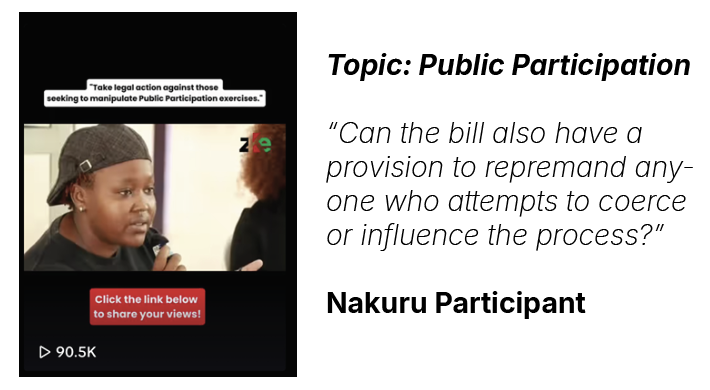
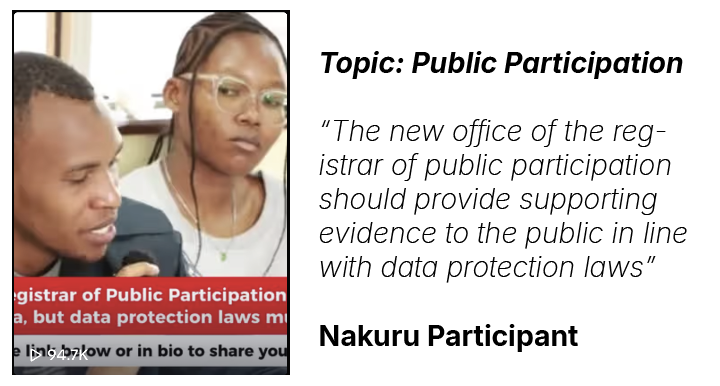
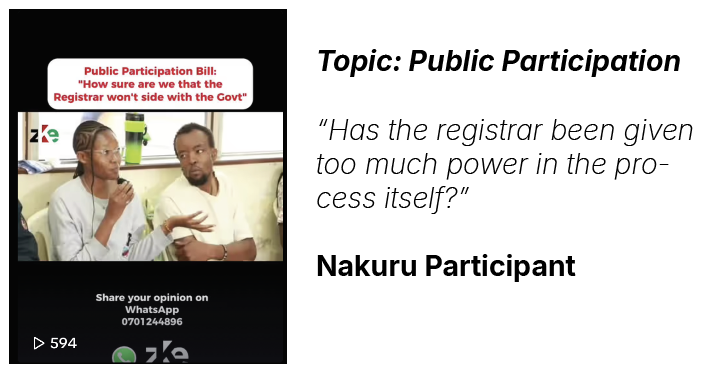
“The public participation process needs to be revisited to ensure more inclusive participation, because the process is currently inaccessible to many people.”
Youth baraza participant
“The office of the public participation registrar has been given a lot of power that could end up influencing the public participation process.”
Youth baraza participant
On air and online
TikTok Live, radio and TV
In a TikTok Live conversation, most young people said the time allowed for public participation is too short and the process too exclusive. Some said elites and interested parties guard the process to keep out people who disagree with the government’s bills.
On Spice FM’s The Situation Room, broadcast on radio, KTN TV and YouTube, two young guests, Bright Shitemi of the volunteer movement Kikao and the activist Beatrice Ouma, discussed the bill. They named robust feedback, civic education and inclusion as the keys to public participation, and lack of information, short timelines and public scepticism as the barriers. Opinions were divided on whether a Registrar of Public Participation is needed.

What happened next
A memorandum to the Attorney General
zKe submitted a memorandum with 10 key recommendations from the public deliberation. The Office of the Attorney General acknowledged receipt.
zKe monthly report, November 2024
The memorandum drew on the barazas, the X Spaces, radio and TV and the pol.is votes. zKe said it would follow which recommendations are adopted in the bill.
See every statement and vote
The pol.is report shows how each of the four opinion groups voted on every statement.
Keep reading
More conversations

October 30, 2026
How to reduce unemployment in Kisumu County
Deliberative conversation · Open now · October 2026 How to reduce unemployment in Kisumu County “What actions do you think Kisumu County government should…
Read more
October 28, 2026
Livestreaming the 2027 election results
Deliberative conversation · Open now · October 2026 Should IEBC continue livestreaming election results? “Should results from every polling station be livestreamed in the…
Read more
October 23, 2026
Solutions to flooding in Nairobi
Deliberative conversation · Open now · October 2026 Solutions to flooding in Nairobi “To stop Nairobi’s recurrent flooding, what priority step or rule should…
Read more