
Social media analysis · Monthly report
Kenya’s election conversation online
From July to early October 2026, violence at political meetings, ethnic hate speech, attacks on Burundians and doubts about the voter register ran alongside a fractured opposition. This report follows twelve narratives, starting with the threats most directly linked to violence.
Period1 July to 13 October 2026
PlatformsFacebook, TikTok, X and YouTube
Posts analysed9,034
Comments reviewed~210,000
At a glance
Twelve narratives, ten months before the vote
Kenya’s next general election is on 10 August 2027, and its elections have often been accompanied by violence, most severely after 2007. This snapshot looks for early signs that 2027 could follow the same path, and is part of a series by zKe and its local partners supporting an integrated online and offline approach to peacebuilding.
9,034
posts across twelve narratives, with about 7 million likes and ~424,000 comments
1 in 12
sampled comments was harmful; under posts about the Homa Bay violence, 1 in 7
191
comments of ethnic hate speech, and 104 that threatened or called for violence
385
near-identical posts and replies from 47 X accounts in under four hours on 27 September
Background
Two splits in the opposition
In the Mount Kenya region, former Deputy President Rigathi Gachagua built the Democracy for the Citizens Party (DCP) into the main opposition vehicle after his impeachment in October 2024, campaigning under the slogan ‘Wantam’ (one term for President William Ruto). Ndindi Nyoro, elected on Ruto’s United Democratic Alliance (UDA) ticket, left UDA in early July and on 17 August unveiled the People’s Party of Kenya (PPK).
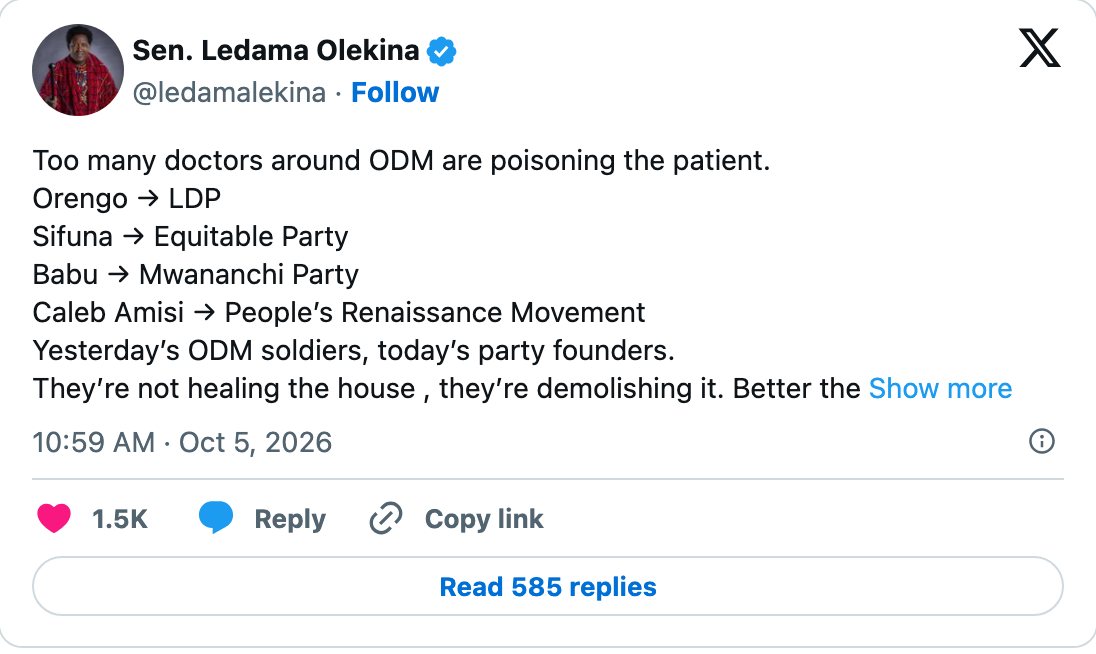
In the Orange Democratic Movement (ODM), part of the leadership joined Ruto’s ‘broad-based’ government after Raila Odinga’s death in October 2025, while Edwin Sifuna and Babu Owino led a breakaway movement, Linda Mwananchi (‘Protect the Citizen’). Unable to register a party under that name, Babu Owino took over the Muungano Party, renamed The Mwananchi Party (TMP), and on 4 October Sifuna launched The Equitable Party (TEP).
Throughout, Ruto and his allies described the new opposition as the work of former President Uhuru Kenyatta. Meanwhile the electoral commission (IEBC) was registering voters, projecting a register of about 28.5 million against 22.1 million in 2022, and buying new election technology.
Key findings
28 findings in six themes
The findings are ordered by how directly they bear on a peaceful 2027 election. Choose a theme to see its findings; each is explained in the chapters below.
Harmful comments
One sampled comment in twelve was harmful, one in seven under posts about Homa Bay, and the most serious content set communities against each other.
Xenophobia towards Burundians
A directive on foreign traders was followed by harassment, looting and displacement of Burundians, a ‘fake voters’ conspiracy, and a strong Kenyan pushback.
An Eldoret lecturer’s warning
A lecturer’s warning that students from Mount Kenya and Western should not return to the University of Eldoret if Ruto lost was read as ethnic exclusion.
Homa Bay: blame and death tolls
Each side blamed the other for the violence in Homa Bay on 16 August, and death tolls far above the reported figures circulated widely.
A verdict on the Luo community
The violence was turned into a verdict on the Luo community, and calls followed to keep Luo leaders out of Western Kenya.
Violence in Embu
Four weeks later, a meeting led by Deputy President Kindiki in Embu ended in teargas, burning vehicles and at least one reported death, after a month of warning signs.
The voter register
Each side accused the other of padding the voter register: with foreigners from Uganda, or with ‘fake Kikuyu voters’.
Technology and the tallying centre
Disputes over election technology and the national tallying centre were argued as rigging plans before the rules were settled.
Live streaming of results
A post claiming the IEBC would not stream 2027 results live drew more comments than all the posts carrying its denial.
The party registrar
The registrar of political parties was overruled by a tribunal, and its silence when sign-ups to Sifuna’s party failed left claims of state interference unanswered.
The NCIC
The NCIC was criticised for its silence before Homa Bay and derided after its determination; none of the politicians it summoned faced charges in the data.
The police
Police responses to political violence were judged by whose side they appeared to favour, and the police’s own account is absent from the data.
The courts
Courts and tribunals were where criticism of institutions was tested, and each ruling was claimed by the side it favoured.
Rumours about Oburu Oginga
Rumours that ODM leader Oburu Oginga had died spread fastest when official information was thinnest.
Ebola and the election
Kenya’s first Ebola case was met within hours by claims that it was invented, imported for money or meant to postpone the election.
Dead voters
A UDA official’s reported remark about dead voters was taken as proof of a rigging plan, and old audit figures presented as new outperformed the IEBC’s explanation.
Nyoro and the ‘mole’ frame
Nyoro’s new party was received as a loyalty test, and the ‘mole’ accusation became its defining frame.
Reformer or insider
Two competing portraits of Nyoro, a persecuted reformer and a compromised insider, were both reinforced by events offline.
A coordinated burst
A burst of 385 near-identical posts on X promoted a Matiang’i and Nyoro ticket ‘backed by Uhuru Kenyatta’, in a pattern that looks coordinated.
Nyoro attacks Ruto
Nyoro answered the ‘mole’ charge by attacking Ruto; the attacks drew twice the engagement of the charge, but his audiences stayed unconvinced.
Membership numbers
Unverifiable membership numbers became the main measure of Sifuna’s new party, and the party registrar became a target.
Attacks on TEP’s legitimacy
Opponents attacked TEP through ‘Mr Empty’ mockery, calls for a by-election and contradictory stories about who owns the party.
A fragmented movement
TEP’s launch exposed a fragmented Linda Mwananchi movement and an ethnic map of the opposition.
Babu Owino’s party
Babu Owino’s new party was read as a betrayal of Sifuna, and his opponents in ODM attacked his Luo identity.
‘The sponsor’
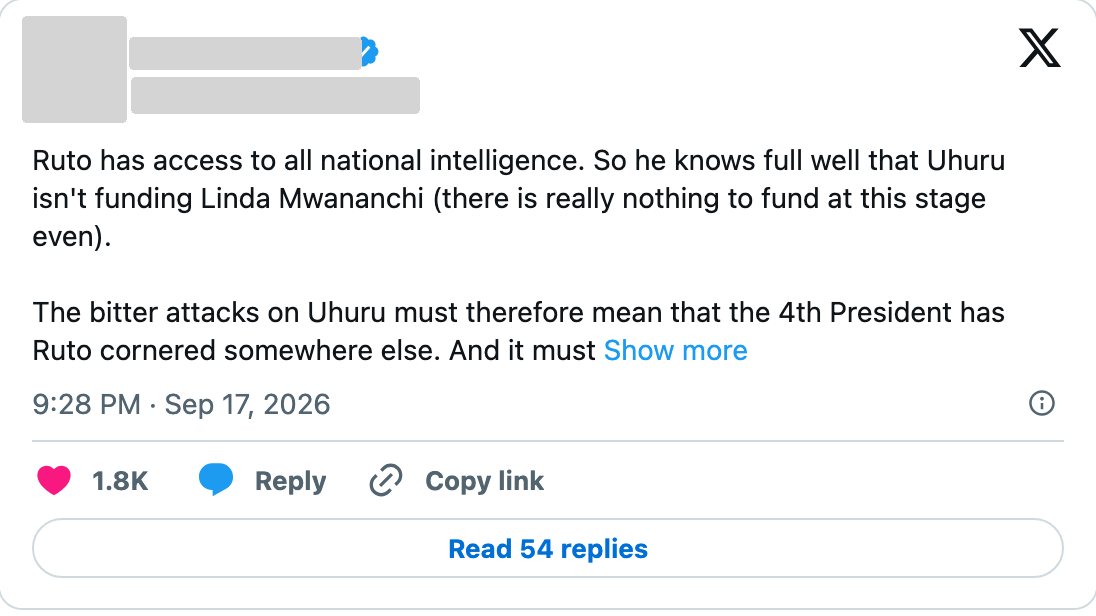
The claim that Uhuru funds and controls Sifuna was pushed from the top, by Ruto and his allies, with large but unverified sums.
Denials travelled less
Denials reached far fewer people than the claim, and the claim itself circulated in contradictory versions.
An ethnic plot, with threats
Senior politicians recast the ‘sponsor’ claim as an ethnic plot, and it came with threats.
Uhuru’s joke
Uhuru turned the ‘sponyo’ label into a joke, and his replies drew more engagement than the attacks on him.
Part 1 · Findings 1 to 3
Hate speech and incitement to violence
Hand-reading a random sample of 2,690 of the ~210,000 comments collected put the share of harmful comments at 8.4%. Facebook threads were far more hostile than TikTok: 10.6% of sampled Facebook comments were harmful, against 3.6% on TikTok.
Share of sampled comments judged harmful, by narrative
Random sample of 300 comments for three narratives and 200 for the others (Source: Phoenix)
Harmful comments found by the severe-content screen, by category
Comments caught by a keyword screen in English, Kiswahili and Sheng and judged harmful on reading (Source: Phoenix)
Most of the harm was harassment: insults aimed at politicians, such as ‘mlevi’ (drunkard) for Uhuru, ‘Mr Empty’ for Sifuna, ‘mole’ and ‘hyena’ for Nyoro, ‘Muhindi’ for Babu Owino, ‘Gladys Panga’ for Governor Wanga and ‘Kasongo’ for the President. The more serious content falls into four groups.
Hate speech
Circumcision slurs against Luo people, a long-standing taunt that accompanied forced circumcisions during the violence after the 2007 election. They clustered under posts by or about Luo politicians attacking Sifuna, who is Bukusu. Others cast whole communities as hyenas, slaves or violent, or told a Somali Kenyan MP and Babu Owino to ‘go back’.
Threats and incitement
Threats of forced circumcision, death threats against MP Peter Kaluma and Governor Wanga after Homa Bay, threats against electoral officials, and calls to burn MPs’ houses or shoot ‘goons’ on sight. Sixty-four of the 104 were on Facebook, and 46 were under posts about Homa Bay.
Mis/disinformation
Claims that Ruto ‘killed’ Raila Odinga, that the IEBC was ‘caught red handed registering Somalians and Ugandans’, that an Ebola quarantine centre was a plan against one community, and premature reports of Oburu Oginga’s death, none with evidence.
Gendered abuse
Mostly after Homa Bay and aimed at Governor Gladys Wanga, the most senior woman among the figures in this report, calling her a disgrace to ‘motherhood, womanhood, sisterhood’.
The harm was not coordinated
The 595 harmful comments came from 572 different accounts, and 96% of those accounts appear only once. The content most likely to shape behaviour offline came instead from politicians’ own posts and from posts that turned events into verdicts on whole communities: a threat attributed to MP Oscar Sudi, MP Peter Kaluma’s ethnic histories, ‘fake Kikuyu voters’, the Speaker’s claim about the Luhya vote, the open letter to the Luo community after Homa Bay, and inflated death tolls.
The same threads carried counter-speech. Luo commenters answered the circumcision taunts directly, readers defended the protection of a KTN witness, and under the rumours about Oburu Oginga a widely liked reply told others to “stop rumour mongering about people’s health”.
“No Kenyan is an outsider.”
Reply to a post saying Mount Kenya would not vote for “another outsider”
“In Kenya even a funeral hug now needs IEBC clearance. Let’s debate policies, not people’s hugs.”
Reply to a claim that a hug from Uhuru was a “political death wish”
“They are not the devils that people talk [about].”
A commenter who had studied and worked in the Mount Kenya region, on the Kikuyu
Xenophobia towards Burundians (Finding 2)
After President Ruto’s directive on 2 September gave foreign-owned small businesses without permits until 7 September to close, 152 posts with ~114,000 likes showed Burundians queuing at their embassy, harassment and looting in Nairobi and Mombasa, and a warning from Burundi’s foreign minister. A man who gave Burundians 24 hours to leave was charged with hate speech, and many Kenyans pushed back: a video of Juja residents stopping a man attacking Burundian traders drew 6,675 likes. The narrative is analysed in full in our special report on anti-Burundian xenophobia.
A lecturer’s warning to students (Finding 3)
In a classroom video that circulated from 24 September, a University of Eldoret lecturer told students that if Ruto served only one term, “do not try to come to this university”: those from Western should go to Masinde Muliro and those from Mount Kenya to Dedan Kimathi. Eighteen posts, almost all on X, drew about 18,200 likes. Posts read the remark in ethnic terms, and Pauline Njoroge, a former Jubilee strategist, asked whether the NCIC would summon him; the data shows no action by the commission.
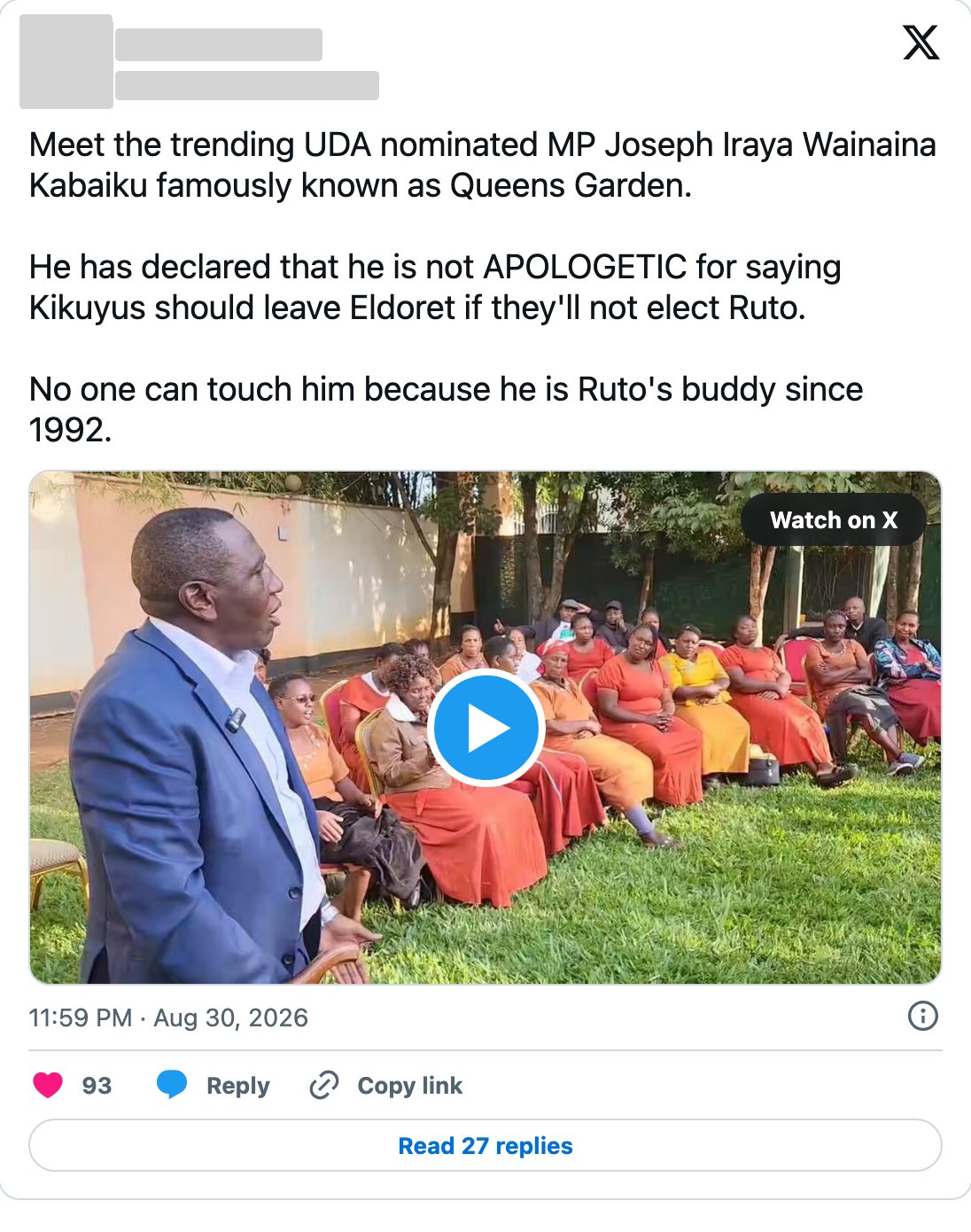
The university’s response was reported three ways: that he had been sacked, that it had disciplined a part-time lecturer, and that he was not on its staff records. The warning echoed a threat a month earlier, when UDA nominated MP Joseph Iraya Wainaina said Kikuyus should leave Eldoret if they did not elect Ruto; the NCIC later summoned the MP.
Part 2 · Findings 4 to 6
Political violence
Violence at a Linda Mwananchi rally in Homa Bay on 16 August, and at a UDA meeting in Embu four weeks later, drew the most dangerous conversations in the data. In both, each side condemned violence against its own and explained away violence attributed to its allies.
646
posts on the Homa Bay violence, with ~632,000 likes and ~42,800 comments
178 to 62
posts blaming the government side against posts blaming Linda Mwananchi or Gachagua
5,381
likes on the most-liked casualty claim, of ‘over 60 dead bodies’, offered without evidence
14%
of sampled comments under Homa Bay posts were harmful, the highest of any narrative
What the Homa Bay narrative was about (share of posts)
Themes are assigned by keyword and a post can carry several (Source: Phoenix)
Forecast
On 8 August a widely shared clip reported Homa Bay Town MP Peter Kaluma warning Linda Mwananchi leaders never to shout ‘one term’ in Homa Bay because “that will provoke people”. On 12 August Siaya Governor James Orengo called a press briefing on “planned violence” against the rally.
16 August
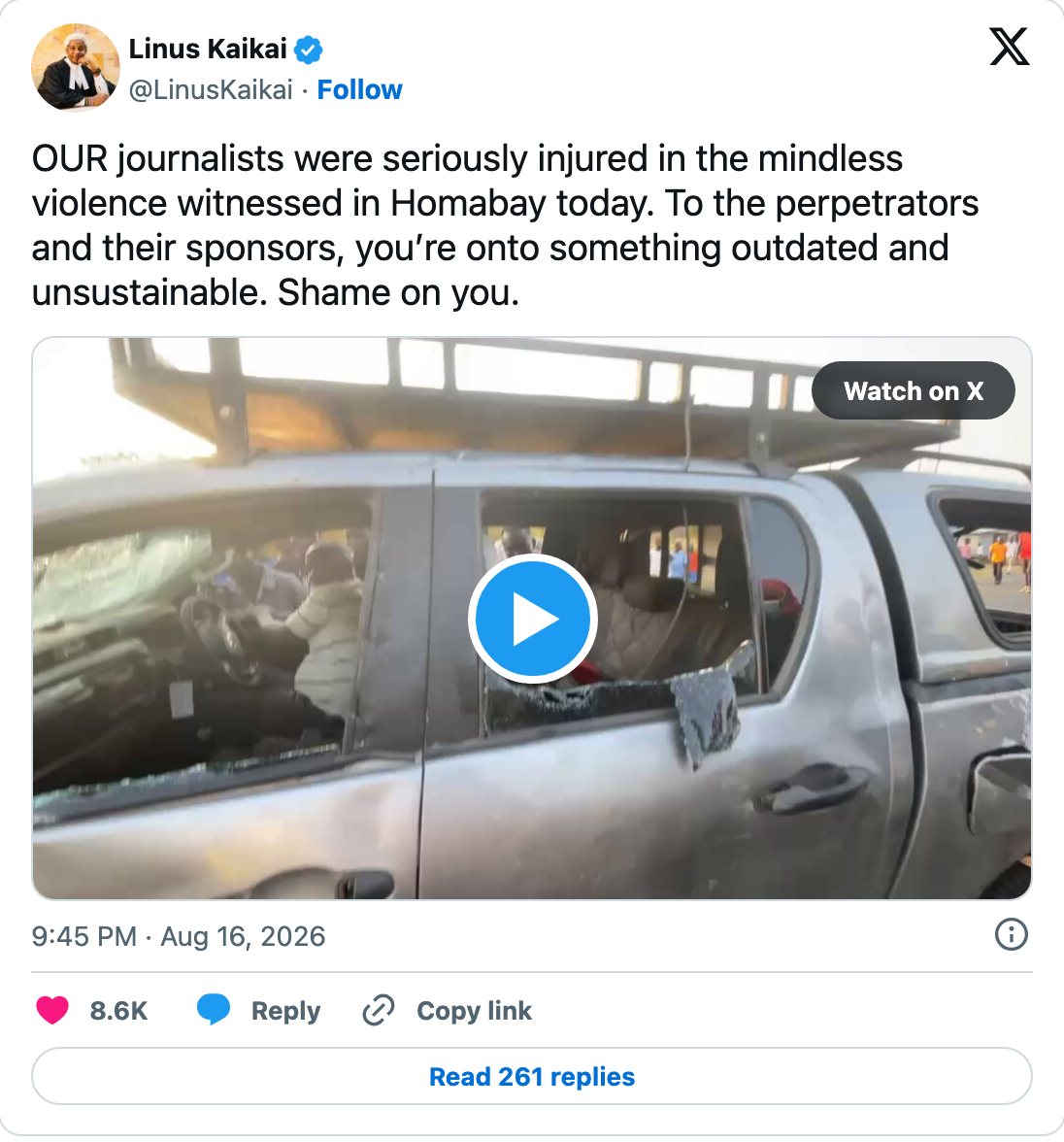
Posts showed roads barricaded around Homa Bay town. By evening, journalists had been injured, the car of a former Bungoma governor stoned, and a hotel and church offices damaged. Early reports spoke of “at least two people dead”, including a police driver.
Blame
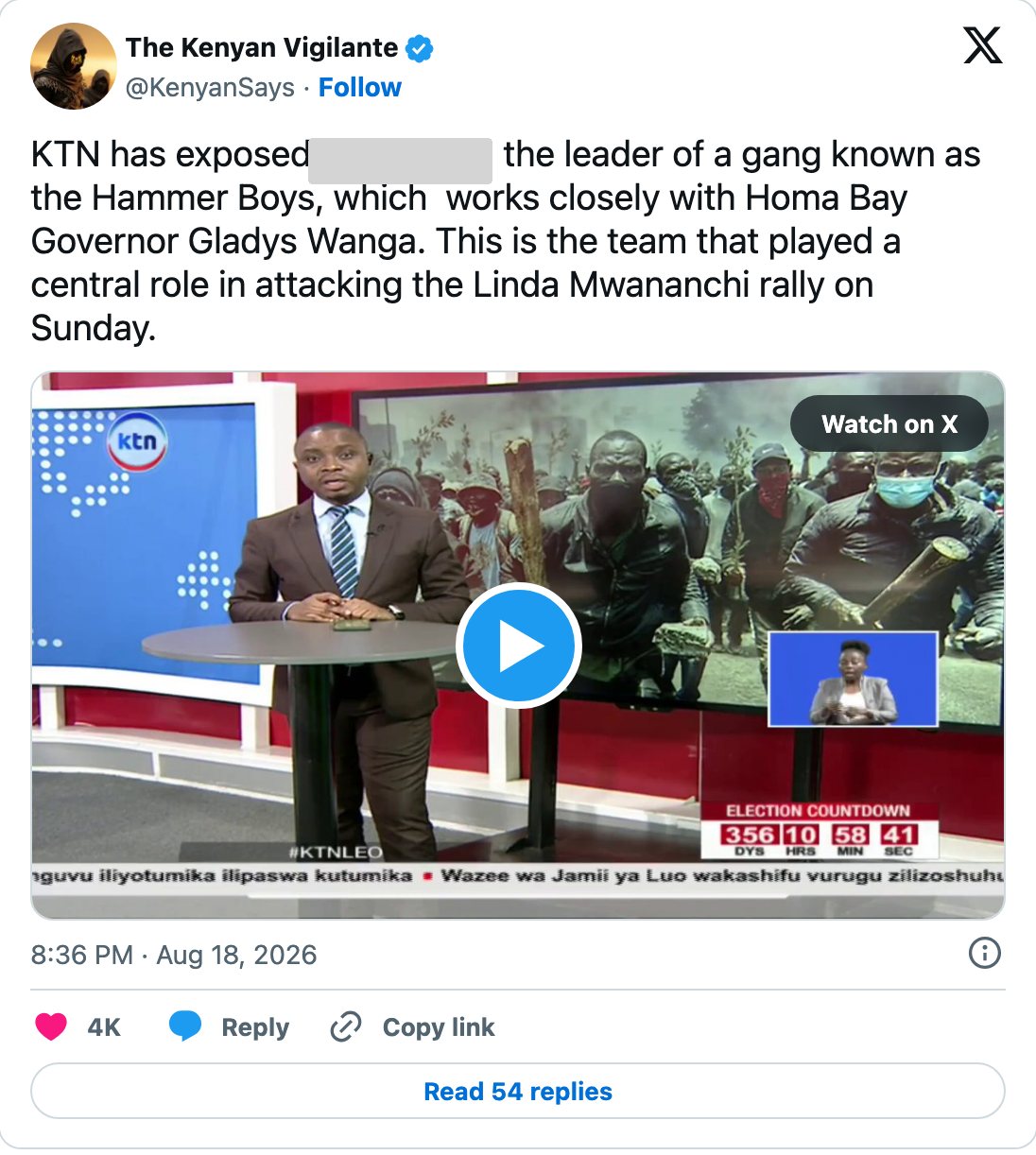
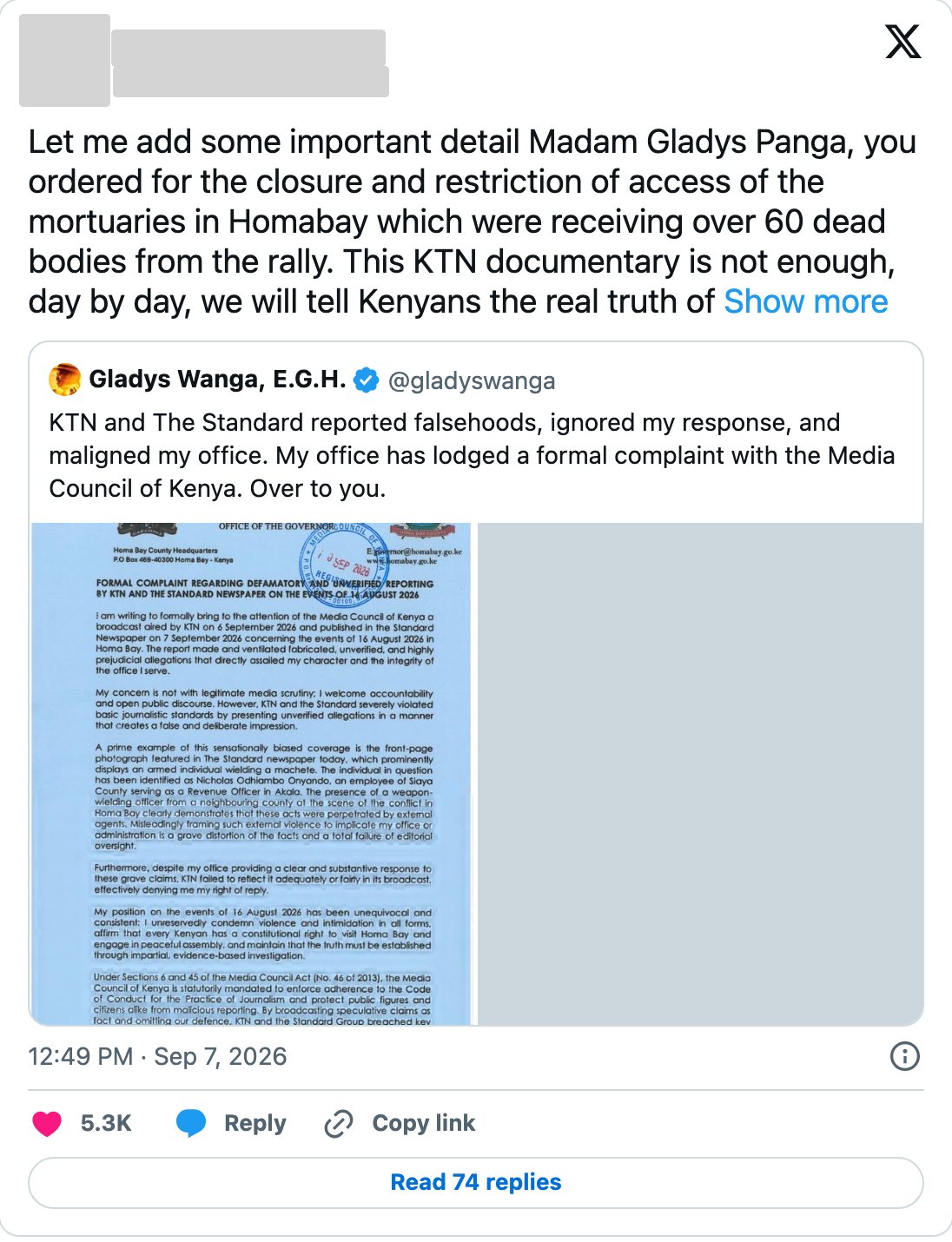
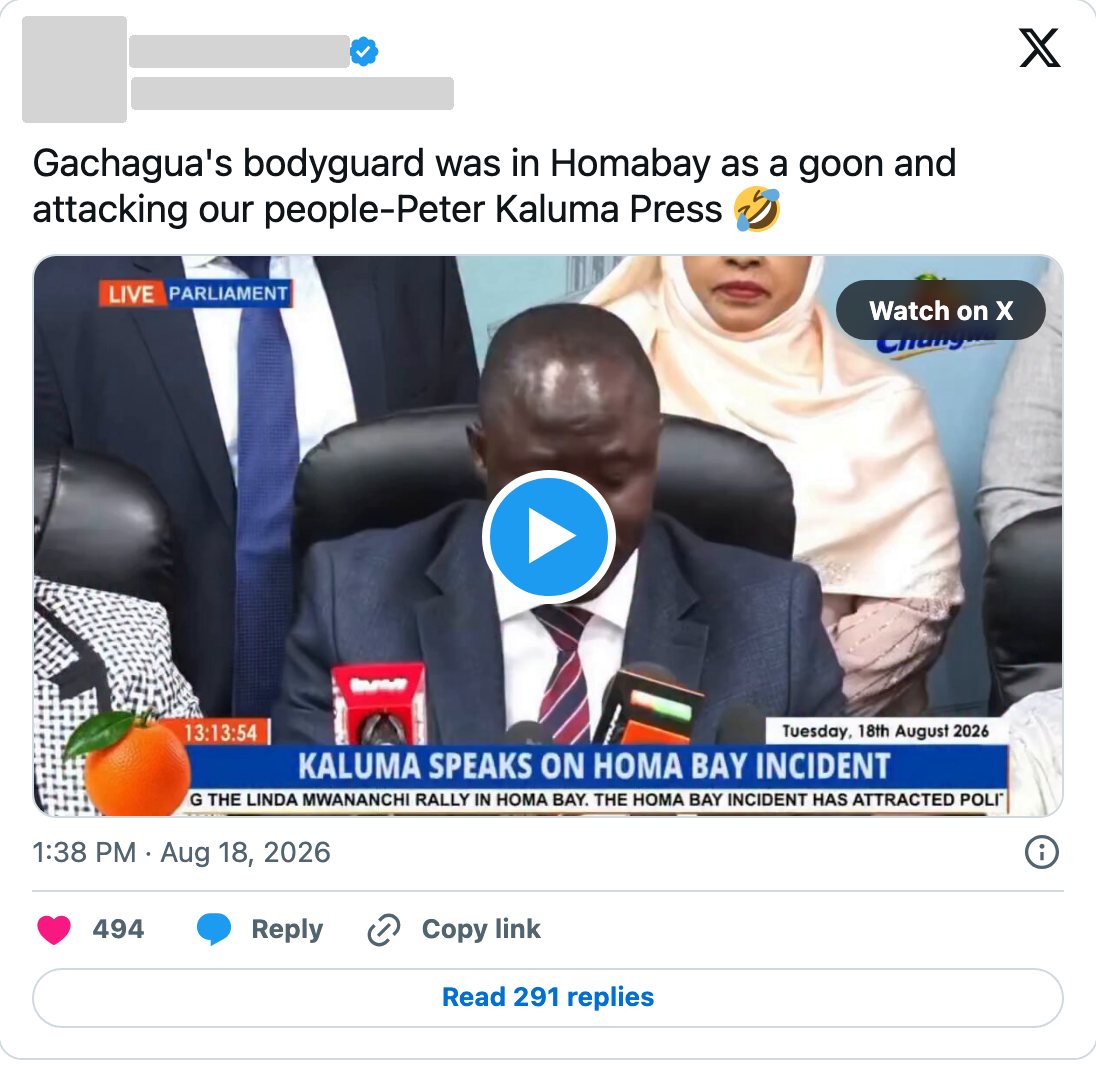
Wanga acquired the nickname ‘Gladys Panga’ (a panga is a machete). On 18 August KTN named a gang, the ‘Hammer Boys’, and its alleged leader. The government side told the opposite story: Kaluma said a bodyguard of Gachagua’s had directed the violence and that Uhuru had sent Sh100 million “to Orengo in suitcases”. Wanga complained to the Media Council that KTN and The Standard had “reported falsehoods”.
A contest over the dead
A post citing The Standard put the toll at four; others claimed over 60, or 500 people cut with machetes, and compared the events to the Wagalla massacre. None came with evidence, and no police, government or independent count appears in the posts. Reports of sexual violence against women in the Linda Mwananchi entourage circulated without a victim’s account or official confirmation.
An arrest seven weeks later
The NCIC summoned Kaluma after the violence. The alleged gang leader was arrested at the Homa Bay bus stage on the night of 8 October (3,097 likes).
Swipe or scroll sideways to see all the posts. Tap a post to enlarge it.
A verdict on the Luo community (Finding 5)
Former Cabinet Secretary Peter Munya’s Facebook post, “An open letter to perpetrators of violence among the Luo community”, drew 1,934 comments. The most-liked replies rejected advice addressed to one community, and one reader put it plainly: “when violence occurs in Luoland, the entire community is sometimes blamed”. Commenters linked Luos with violence or folly in 155 comments, often as ‘Luos killing Luos’.
In Western Kenya the anger turned outward. A TikTok clip of the activist Nuru Okanga warning Wanga not to set foot in Western drew 40,900 likes, and on 8 October, the day before Wanga was due in Kakamega, an X user called for revenge for what was done to Sifuna in Homa Bay (1,825 likes). The visit went ahead without reported violence. Pleas for restraint came too, some from the government side: Migori Senator Eddy Oketch wrote “We must conduct peaceful campaigns. Violence will only hurt our candidate the President” (5,898 likes), and Homa Bay residents answered: “We are not synonymous with violence, we are known with the amazing and beautiful dishes”.
Embu, 12 September (Finding 6)
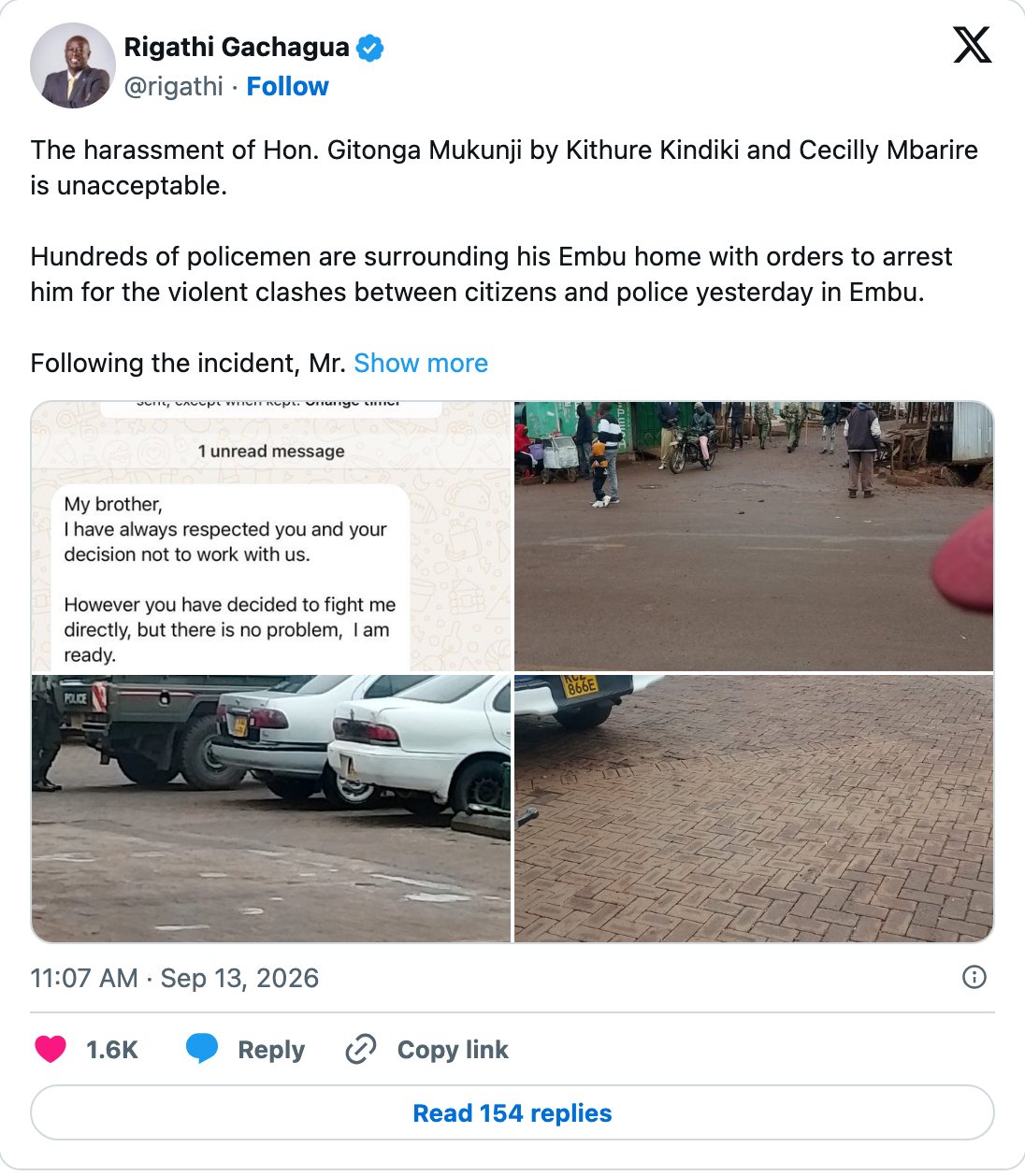
The violence followed a month of warning signs at the same grounds. Local MP Gitonga Mukunji, a Gachagua ally, called a Kindiki meeting part of a plan “to divide the Mountain”; on 28 August a Kindiki meeting at Nembure almost ended in chaos; and on 8 and 9 September Mukunji accused Governor Cecily Mbarire of ethnic profiling of the Kikuyu.
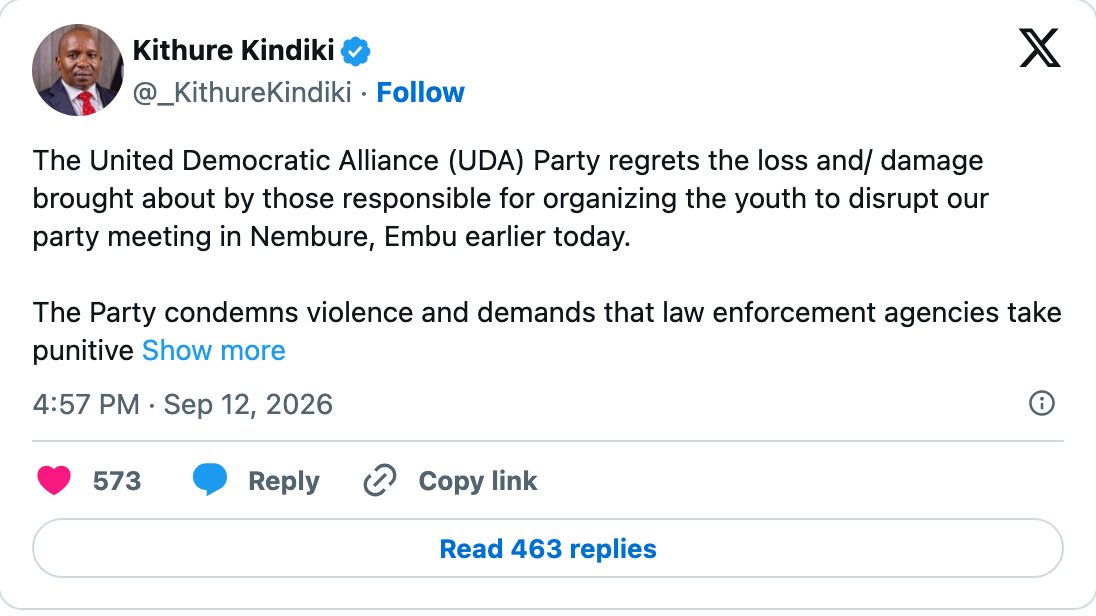
On 12 September a UDA meeting at Nembure led by Kindiki and Mbarire broke up in teargas and burning vehicles, including a Royal Media journalists’ car. Citizen TV reported one person killed and six vehicles torched; YouTube channels claimed up to seven shot dead, and NTV’s “conflicting reports emerge on casualties” was the narrative’s most-liked post (5,328 likes). Police arrested three suspects within two days and deployed outside Mukunji’s home; Gachagua called it “harassment”.
About 95 of 1,582 comments called the violence staged. No post offered evidence for either side’s account.
Other incidents: intimidation and police force
The most widely shared incident involved no injuries: on 20 September Nyoro and Kinangop MP Kwenya Thuku nearly came to blows at a church service, and Nyoro read out messages in which Thuku allegedly warned him to stay away. Some 50 posts drew about 74,000 likes and 1.4 million TikTok plays, more than the violence in Embu.
Teargas became an argument about fairness: it was used at Homa Bay, at a Linda Mwananchi gathering in Makutano, Meru, on 30 August, and at the Deputy President’s own meeting in Embu. Nyoro said: “now you are even using it on your own deputy”; his rivals asked “Why is Ndindi Nyoro never teargassed?”.
Part 3 · Findings 7 to 13
Trust in the electoral process and public institutions
Three narratives concern the electoral commission: the voter register, election technology and the transmission of results. Four other bodies whose conduct bears on 2027 follow: the party registrar and its tribunal, the NCIC, the police and the courts.
‘Foreigners with Kenyan IDs and voter cards’ (Finding 7)
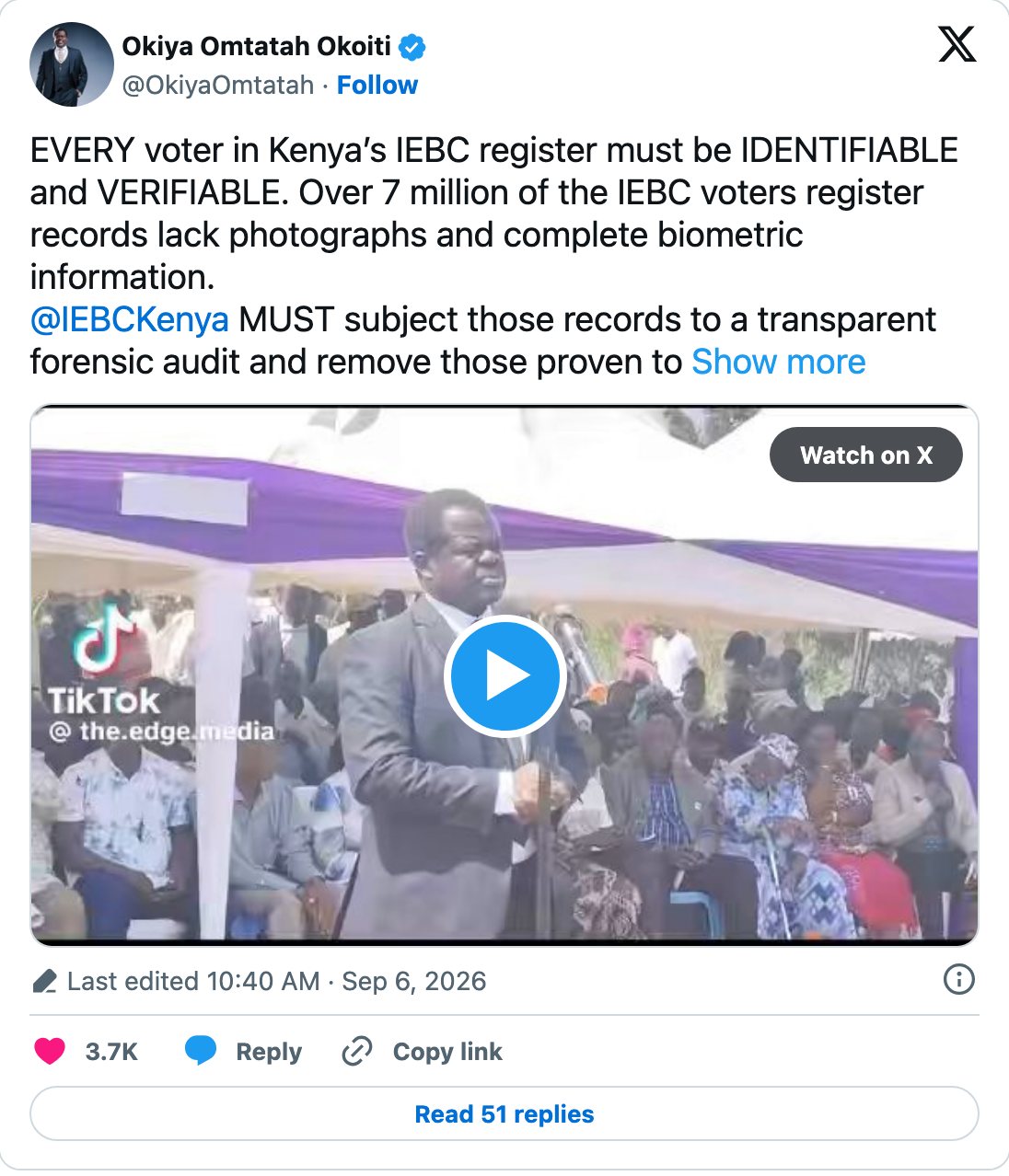
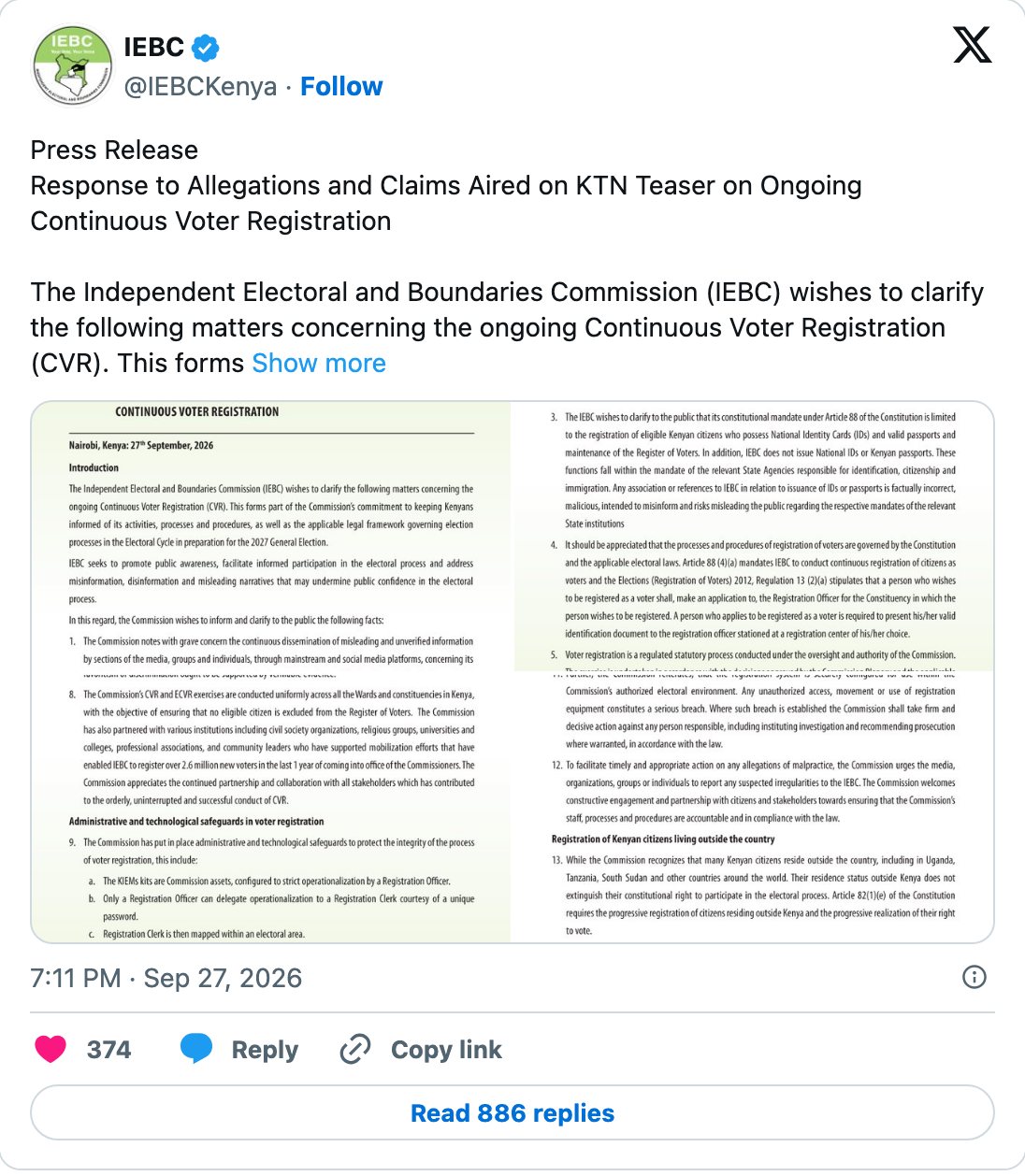
On 6 September Senator Okiya Omtatah wrote that over 7 million register records lacked photographs and complete biometrics, and demanded a forensic audit (3,736 likes). In late September KTN aired claims about voter registration along the Uganda border; the IEBC warned against “misleading and unverified information”, and on 1 October Nyoro told a rally that foreigners were being registered to vote.
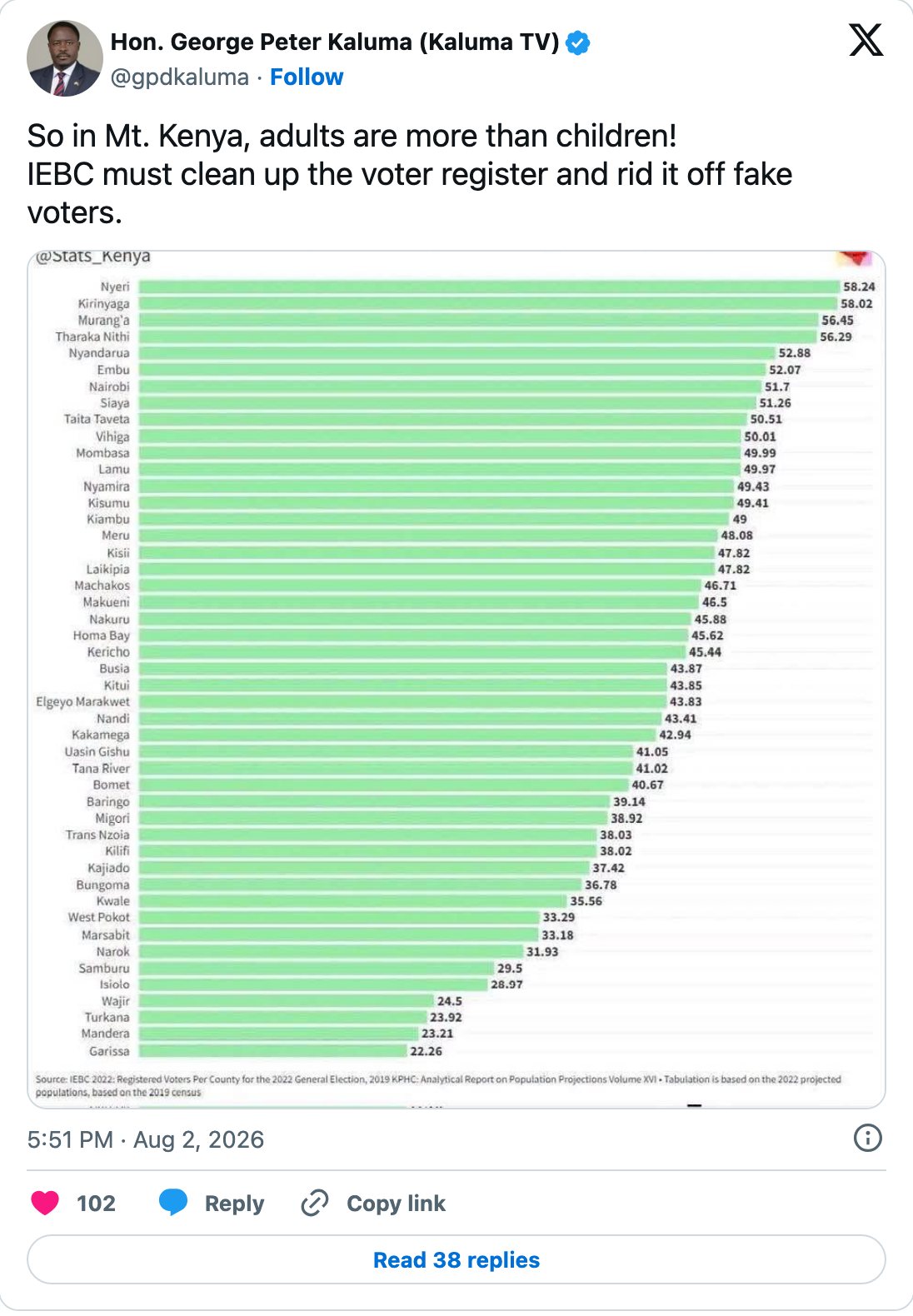
The government side answered with a mirror claim. MP Peter Kaluma wrote on 6 October: “No County in Kenya has more adults than children. Remove the fake Kikuyu voters from the register” (474 comments); the most-liked reply was a circumcision taunt. Both claims named a group of people who should not be counted, and neither came with evidence. Under the IEBC’s statement, the top replies were “This commission thinks we are stupid” (532 likes) and a warning that it would “try to help Ruto rig”.
Swipe to see the posts.
Technology and the tallying centre (Finding 8)
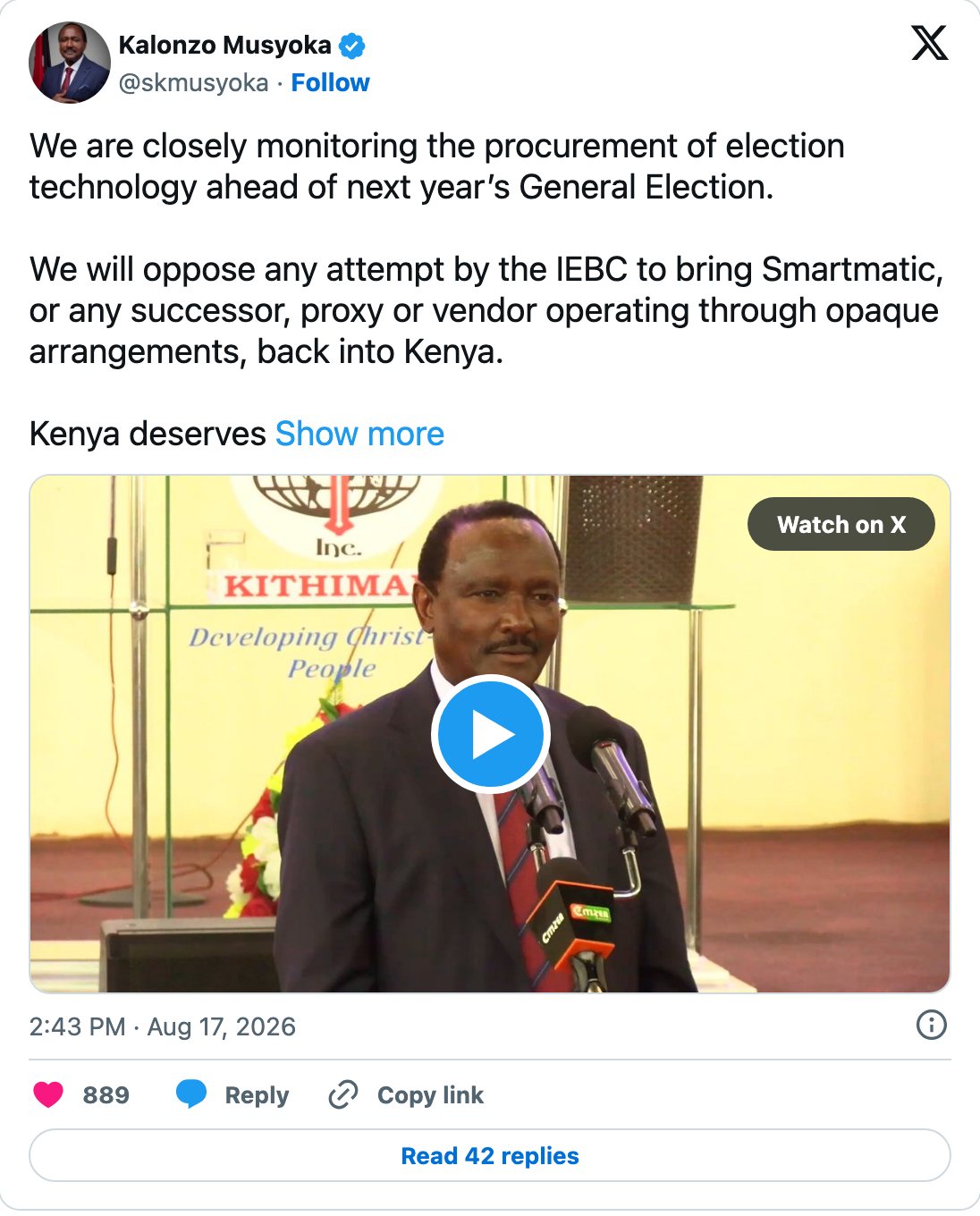
Three posts in five in this narrative mention election technology. Wiper leader Kalonzo Musyoka warned against any return of Smartmatic (890 likes), and on 26 August Gachagua alleged that the IEBC’s tender had been tailored for a South Korean firm, Miru Systems. The commission called this “unsubstantiated and false”; on 4 September the procurement review board ordered the tender reviewed.
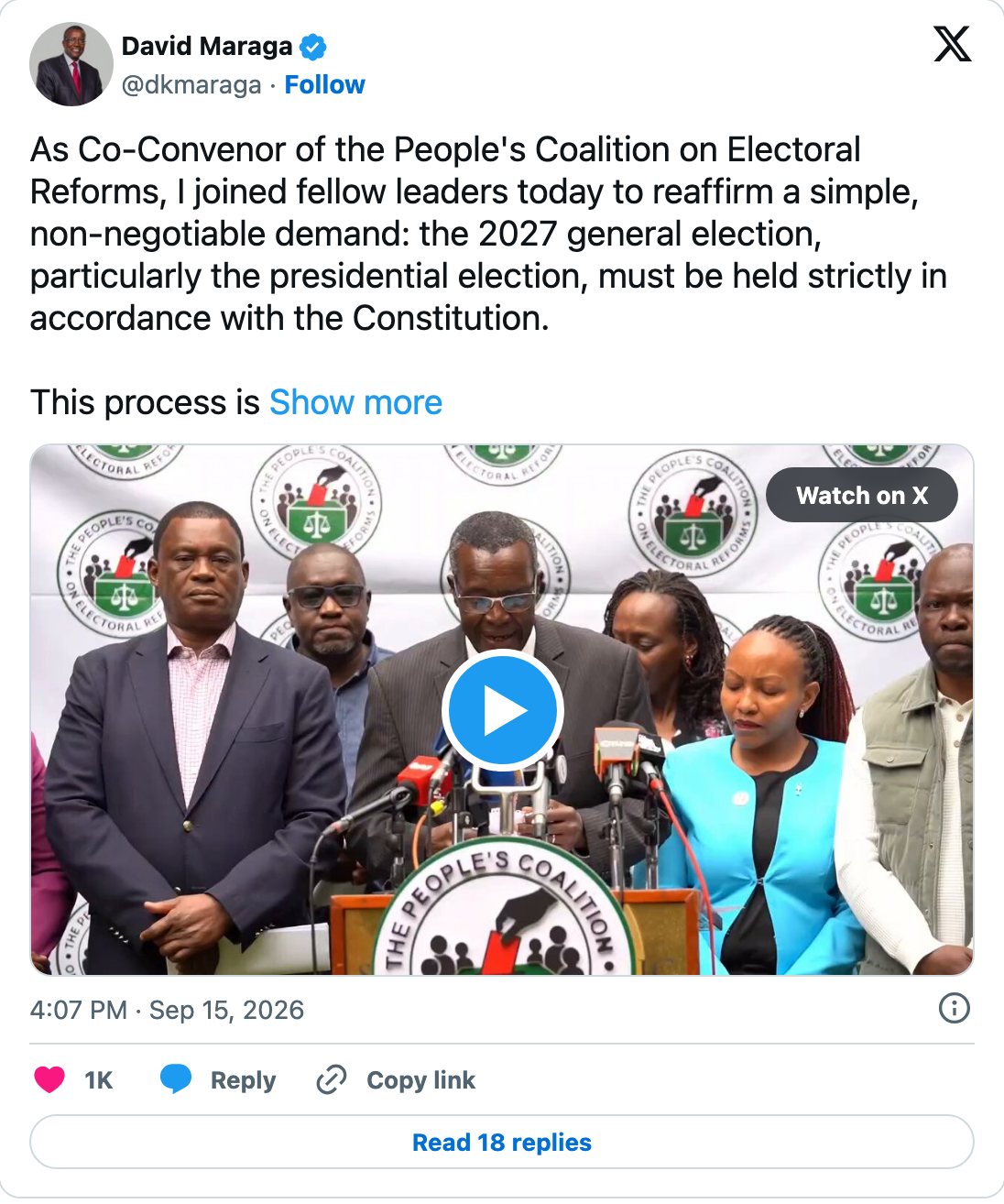
A coalition led by former Chief Justice David Maraga argued that “Elections must begin and end at Polling Stations” and sought to scrap the national tallying centre at Bomas. On 22 September the High Court ruled that it stays. About one post in four alleged past or planned rigging, and some comments threatened IEBC officials by invoking the late chairman Wafula Chebukati.
Who transmits the results (Finding 9)
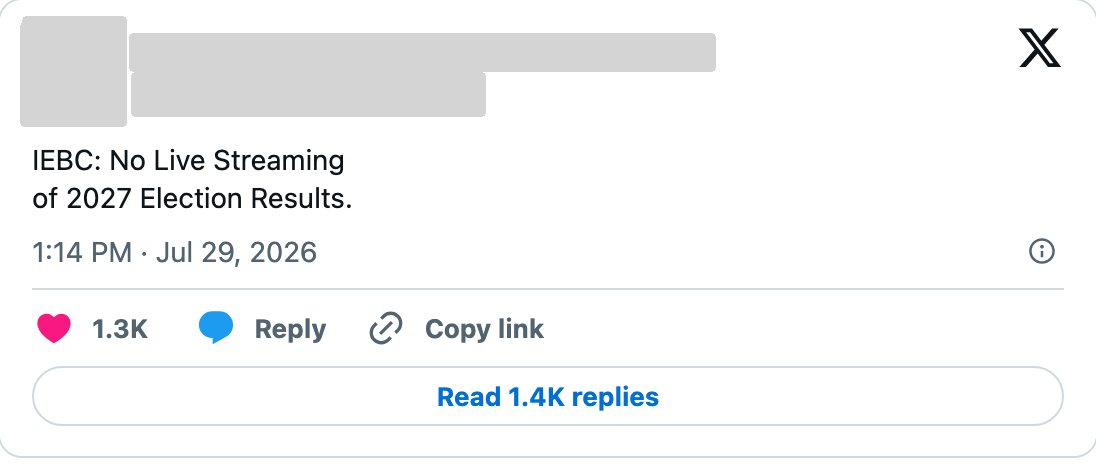
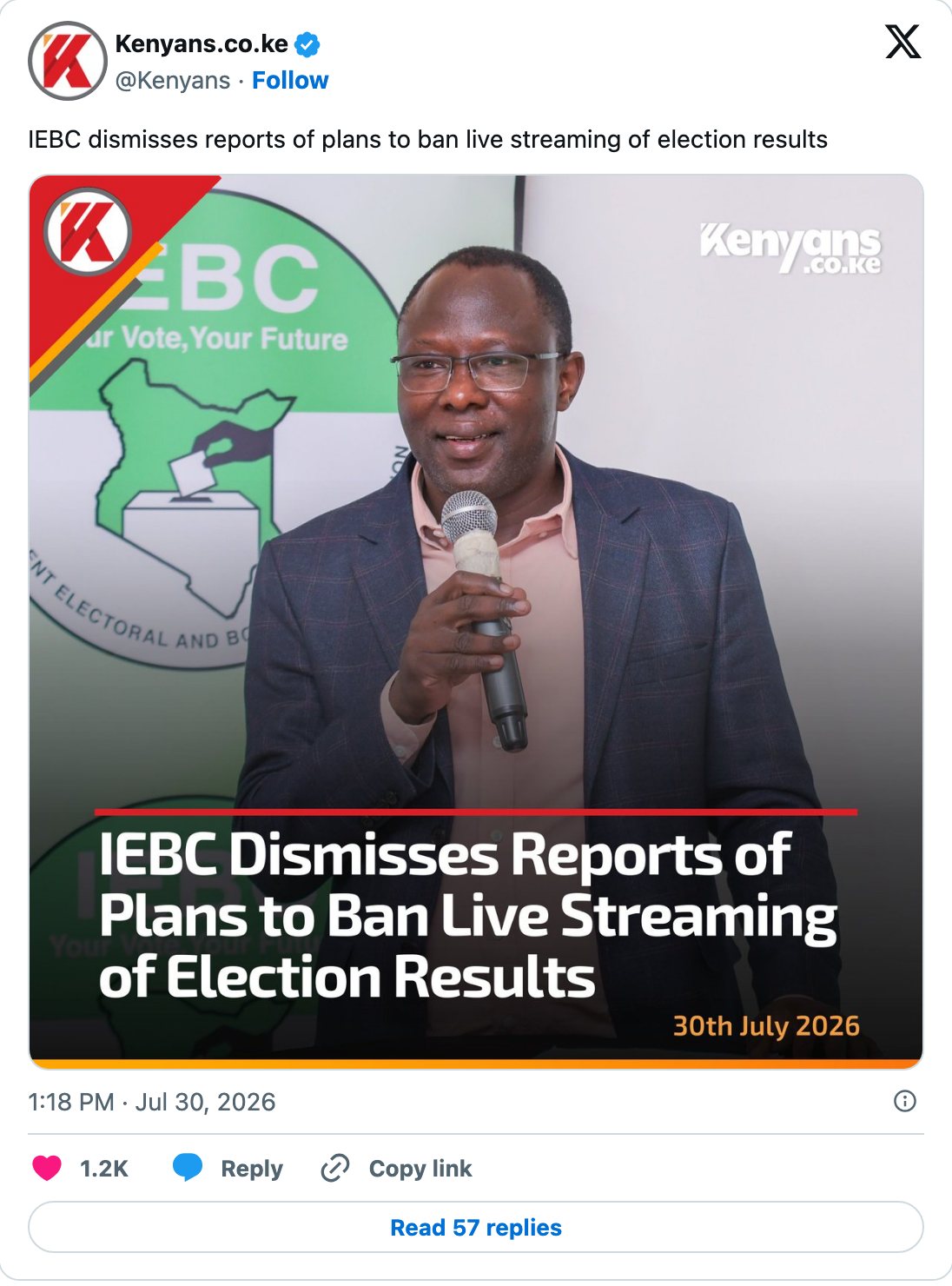
On 29 July an X commentary account posted “IEBC: No Live Streaming of 2027 Election Results”. The next day the IEBC said media reports had misrepresented the Election Laws (Amendment) Bill, 2026, and its chairman said it had made no proposal to stop live streaming. The denial was widely reported, but did not settle the matter: “We shall have an alternative transmitter system. Elections ends at the polling station whether you love it or not”.
1,576
comments on the single post claiming there would be no live streaming
945
comments on all 13 posts carrying the IEBC’s denial, combined
14 of 38
posts in this narrative were unrelated spam from accounts outside Kenya
Other institutions
Open each to see the criticism made of the institution, what it did as far as the posts show, and how its response was received.
The registrar or the tribunal is named in 132 posts with about 102,000 likes. From August, Sifuna’s supporters said the registrar was obstructing Linda Mwananchi after it declined the name, citing similarities with reserved names; at the end of September the Political Parties Disputes Tribunal ruled it had acted unlawfully and ordered the name reserved.
When the *509# code for joining Sifuna’s new party failed in early October, supporters threatened to ‘occupy’ the registrar’s offices and spread #ReformORPP. No explanation from the registrar appears in the data. By 6 October the code worked again, and posts reported the registrar processing the party’s changes.
Before the Homa Bay rally, users asked “NCIC wako wapi?” (where is the NCIC?) about Kaluma’s warnings, and one said formal complaints had not even been acknowledged. After the violence it summoned Kaluma, Busia Governor Paul Otuoma and Cabinet Secretary Geoffrey Ruku.
On 1 October it announced a determination on Kaluma and Otuoma, published only as a link to a document folder. All 18 replies collected under its Facebook post were critical: “Useless commission. Should be disbanded”. None of the politicians it summoned faced charges in the posts collected; the only hate-speech prosecution in the data concerned a private individual. The commission’s own two posts drew 26 likes.
In Homa Bay the complaint was inaction: “why were the police officers watching without action madam”. Interior Cabinet Secretary Kipchumba Murkomen had not commented two days later, and when he did, said the country was “safer than it was during the regimes of Uhuru, Mwai Kibaki, and Moi”. The alleged gang leader was arrested seven weeks later.
In Embu, three suspects were arrested within two days and officers surrounded an opposition MP’s home. Critics read the contrast as partisanship and turned a line attributed to Murkomen back on the government: why go where there are goons? No post from the National Police Service or the DCI appears in the data.
Rulings went the critics’ way on the registrar and the technology tender, and the other way on the tallying centre. The High Court also ruled twice on whether a retired president may take part in politics; each side claimed the ruling that suited it.
One ruling became a vehicle for misleading figures: old audit counts of dead voters were presented as having ‘emerged’ from election records (Finding 16). Direct attacks on the courts were rare.
The Independent Policing Oversight Authority (IPOA) is not mentioned in connection with police conduct at Homa Bay, Embu or the opposition gatherings dispersed with teargas. The Kenya National Commission on Human Rights appears in one post, warning about political violence in Embu (4 likes), and no charge arising from the violence in Homa Bay or Embu appears in the posts.
Part 4 · Findings 14 to 16
Misinformation trends
A claim is described as false when other posts contradict it with first-hand or official information, and as unverified when it was presented as fact without evidence. Claims by politicians are treated the same way. Misinformation clustered in six areas.
Politicians’ health
Rumours that ODM leader Oburu Oginga had died, the clearest misinformation cluster in the data.
Public health
Claims that Kenya’s first Ebola case was invented, brought in for money, or would be used to postpone the election.
The electoral process
No live streaming of results, dead voters to re-elect Ruto, and past elections rigged by altering servers.
Party money and membership
Unverified sums paid to Sifuna’s camp, uncheckable membership counts, and a ‘Nairobi Governor poll’ whose figures add up to 181%.
Violence
Death tolls far above reported figures, and blame pinned on named people without evidence.
Fabricated news and documents
False announcements about party registration and leadership, and a doctored gazette notice for Babu Owino’s party, caught by an ordinary user.
The whereabouts of Oburu Oginga (Finding 14)
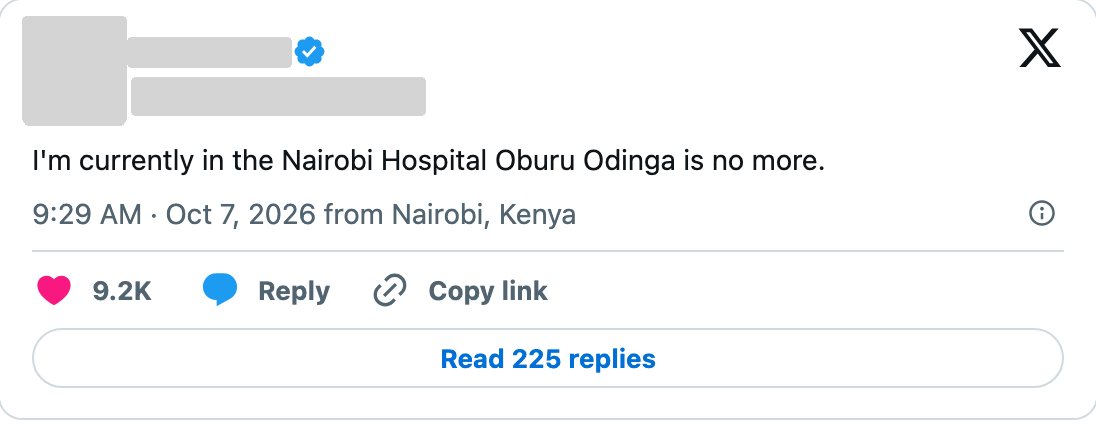
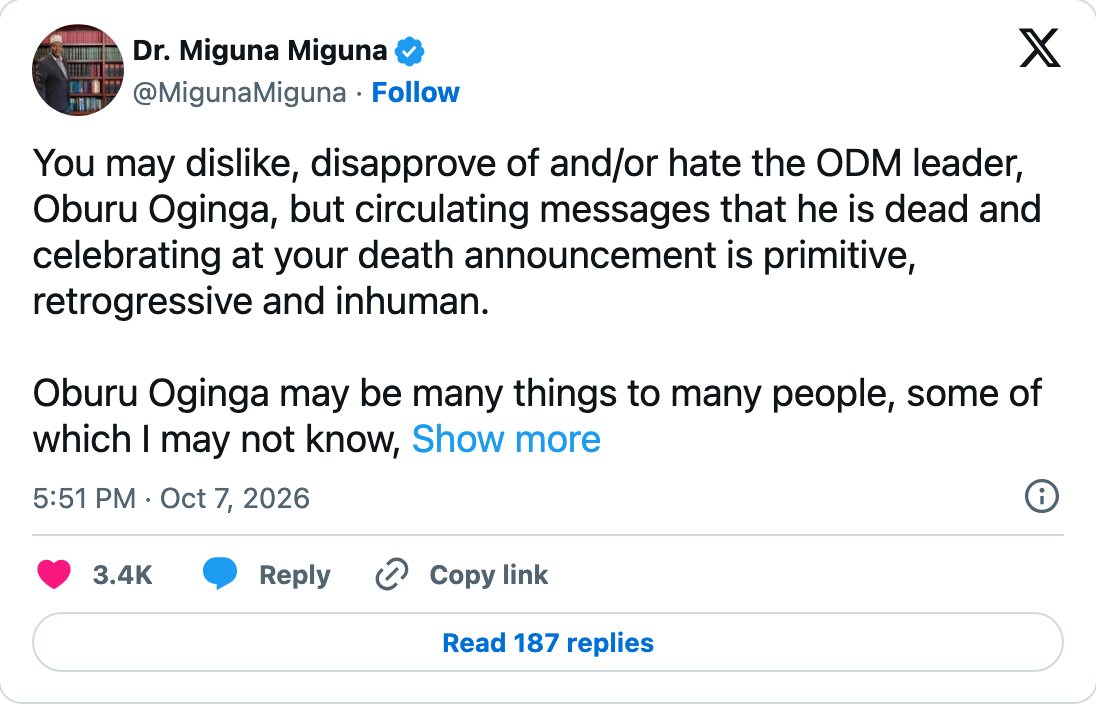
Raila Odinga’s elder brother and ODM leader, Oburu Oginga, was admitted to Nairobi Hospital at the end of August, treated in the United Kingdom, and admitted again on 3 October. With no image or statement from him, claims of his death followed: on 6 and 7 October, 37 posts discussed them, among them “I’m currently in the Nairobi Hospital Oburu Odinga is no more” (9,226 likes). Others added details that could not be checked, about military at a funeral home or oxygen kept on until after the anniversary of Raila’s death on 15 October.
The official answers came late and without proof. Wanga said he was “recovering steadily”, and Ruto said “he is with us” (1,831 likes). Posts asking “Why can’t he record a video to reassure Kenyans that he is alright?” drew 4,998 likes. One sampled comment in eight was harmful, many of them premature condolences or jokes.
Ebola and the election (Finding 15)
On 6 October Kenya confirmed its first Ebola case, a man who had travelled from the Democratic Republic of Congo through Kampala and died in hospital. Within hours one of the day’s most-liked posts declared “There’s no ebola… Either they’re consolidating campaign funds or are planning to postpone elections” (2,273 likes). Others called it a ploy to distract from Sifuna’s new party, and a post quoting Nyoro said Ruto had brought Ebola to Kenya to “eat the Ebola money” from the US government (1,987 likes).
21
posts claimed the case was invented, imported for money or meant to postpone the election
~9,200
likes on those posts
274
likes on the two news reports of the case
2
posts pushed back against the claims
Dead voters and old figures (Finding 16)
On 11 September UDA Secretary General Hassan Omar was reported to have suggested that dead voters’ fingerprints could help re-elect Ruto. The government disowned the remark and the IEBC summoned him and explained why dead voters’ data could not be used to rig. Opposition audiences treated the remark as a confession: Sifuna’s reply, “Even if dead voters vote for Ruto, he will still go home in 2027”, drew 4,310 likes.
On 19 September a TikTok account wrote that “it has emerged” the register held 481,711 voters with double IDs, 164,269 with IDs not in the registry and 246,465 dead voters (2,255 likes, 37,200 plays). The dead-voter count came from a 2022 audit, but commenters read it as current: “that’s 1m votes hivo tu”. The IEBC’s explanation, five days earlier, had drawn about 130 likes.
Part 5 · Findings 17 to 24
The opposition realignment
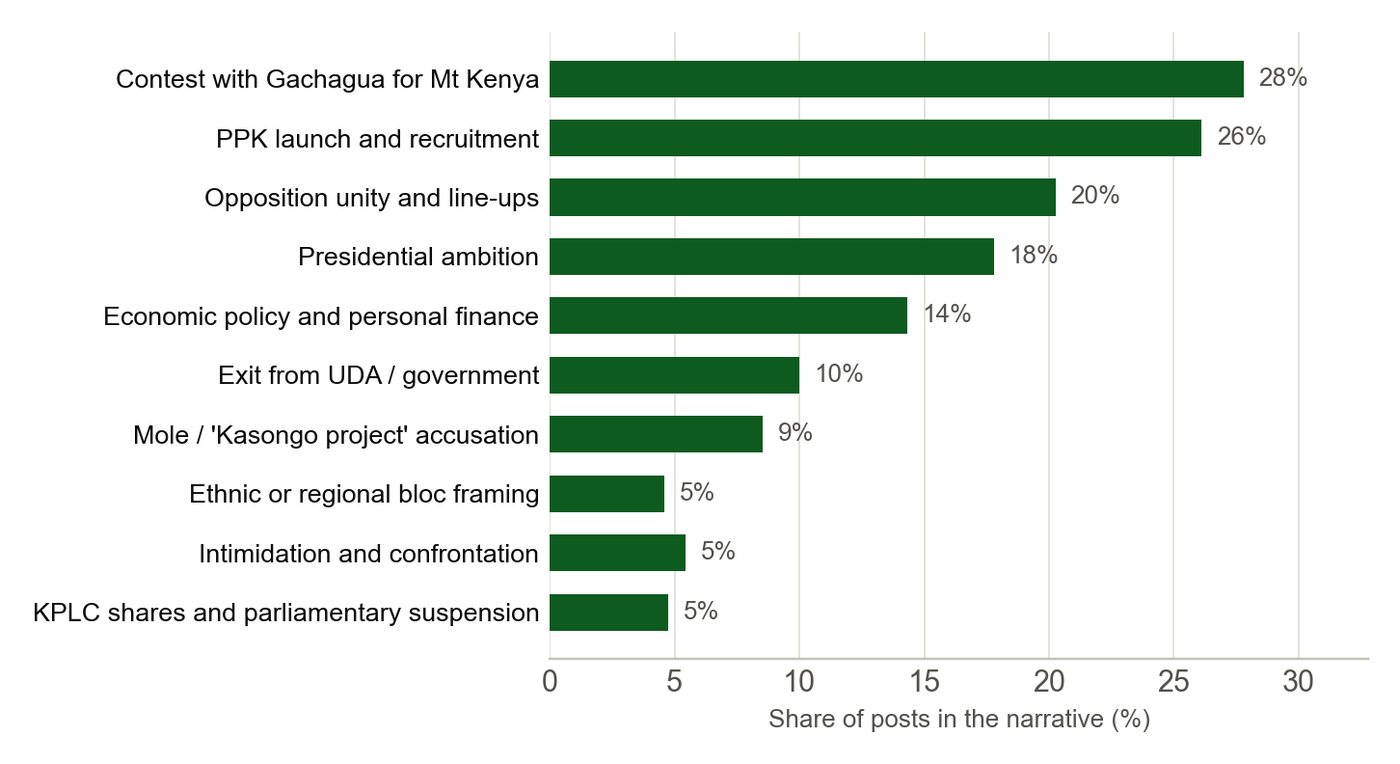
The political contest drew most of the online conversation. Four narratives follow it: Nyoro and his new party, the accusation that he is a government ‘mole’, Sifuna’s new party, and Babu Owino’s.
3,178
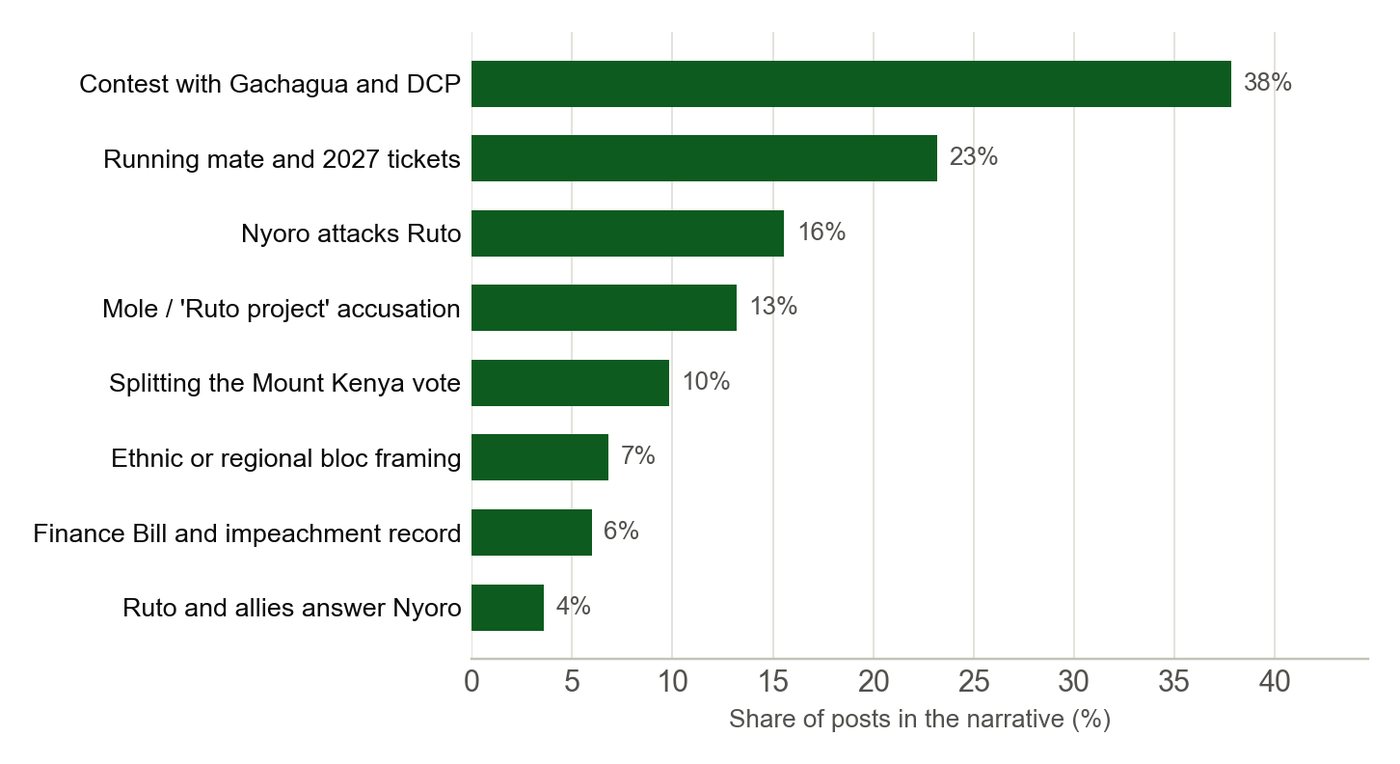
posts on Nyoro and the PPK, with ~3.2 million likes, most of them on TikTok
1,221
posts in the narrative on Nyoro as a ‘mole for the government’
1,399
posts on Sifuna’s new party, TEP, most of them after its launch on 4 October
523
posts on Babu Owino’s new party, TMP
Nyoro’s party as a loyalty test (Finding 17)
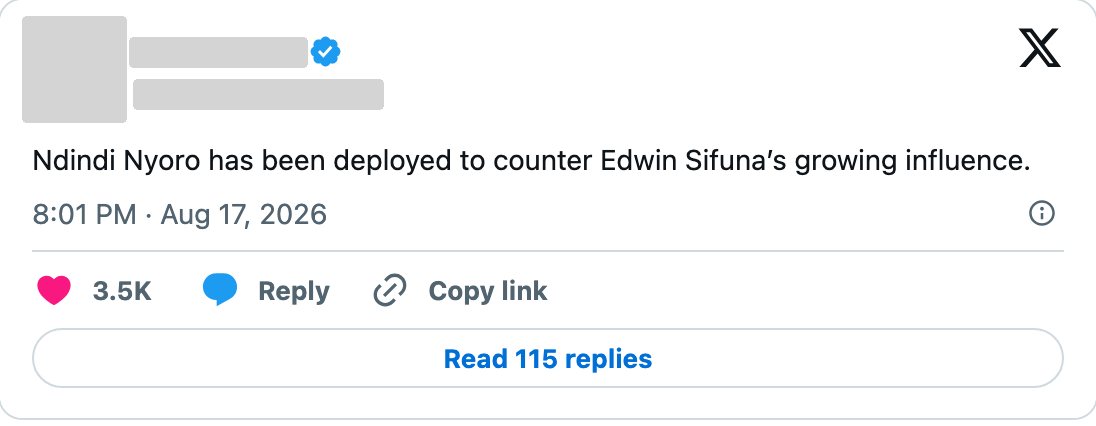
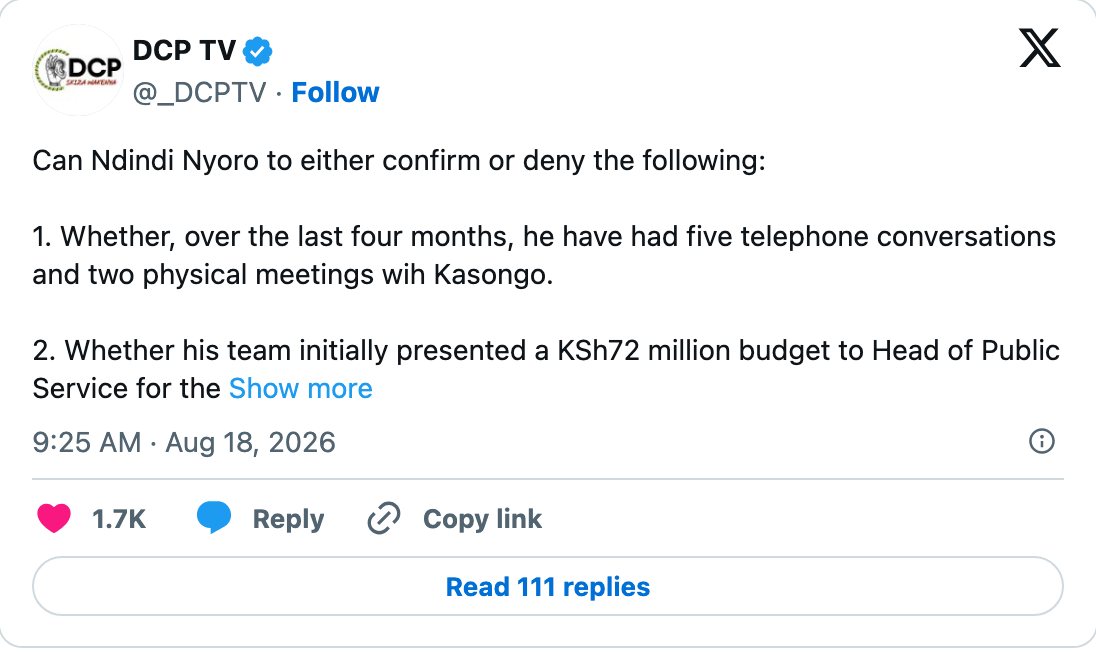
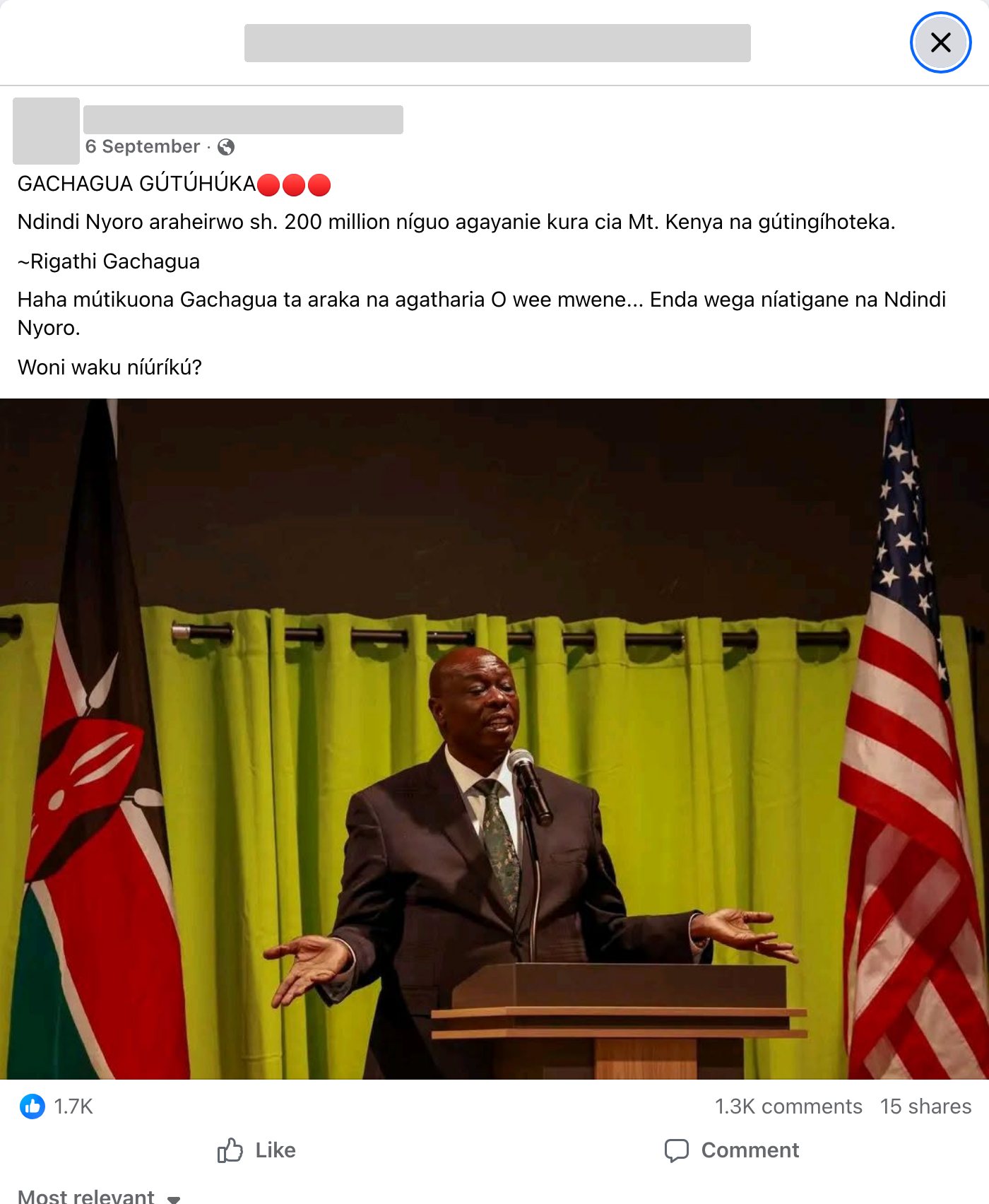
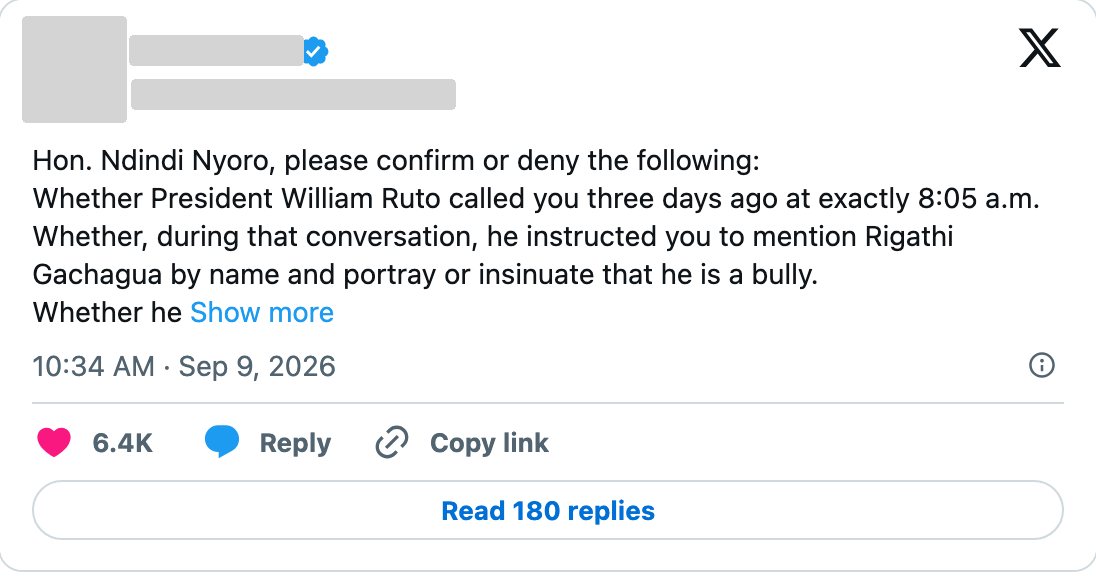
Nyoro announced the move on 17 August: “We left the government a long time ago… from today I have joined the People’s Party of Kenya” (NTV clip, 26,700 likes). Within hours an X account posted that he “has been deployed to counter Edwin Sifuna’s growing influence” (3,574 likes), DCP TV demanded that he “confirm or deny” calls and meetings with ‘Kasongo’, and on 6 September a Gikuyu-language page quoted Gachagua alleging Nyoro had been paid Sh200 million to split the Mount Kenya vote (1,275 comments).
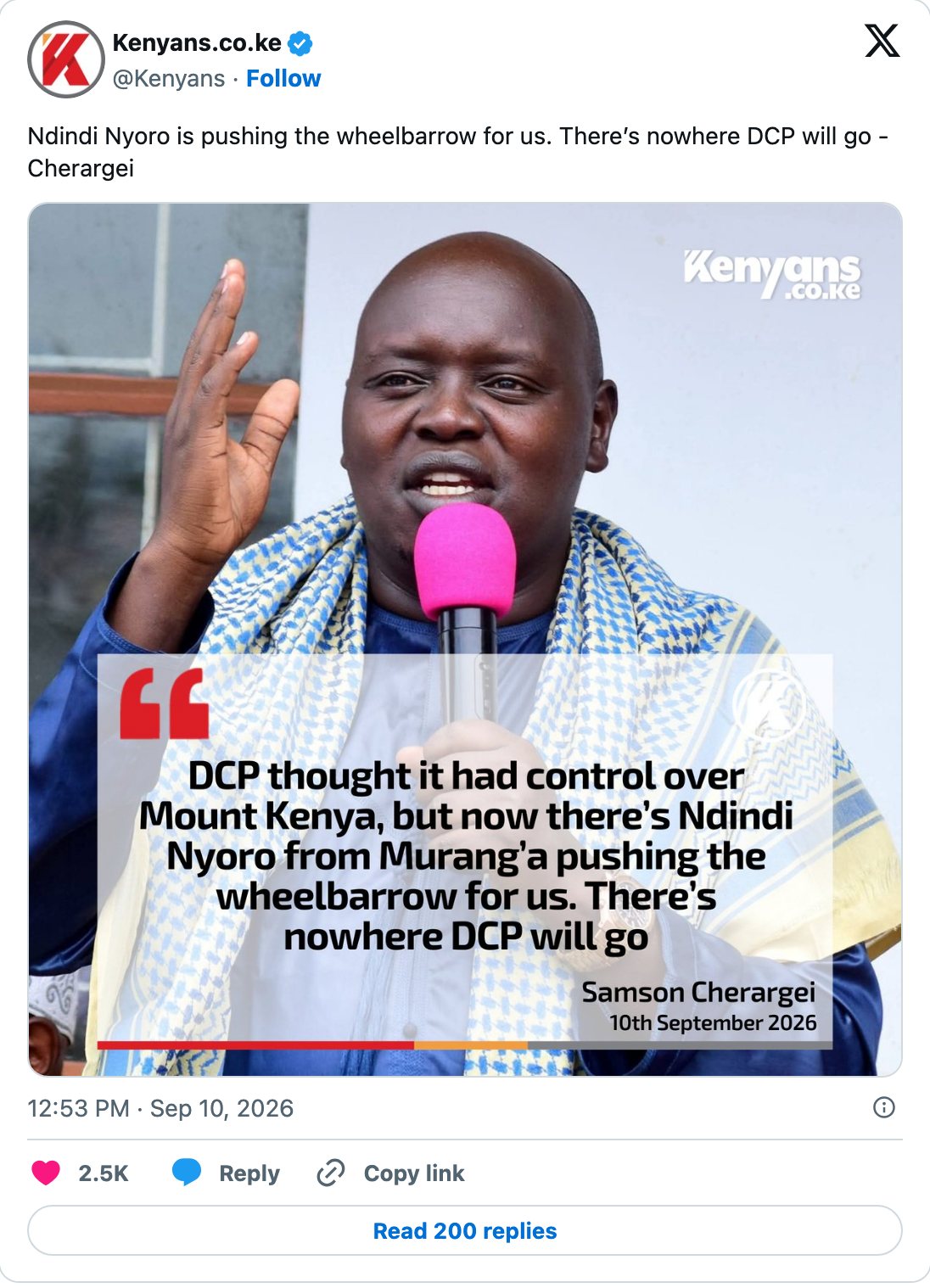
Government allies fed the accusation: Senator Samson Cherargei said Nyoro was “pushing the wheelbarrow for us”, UDA’s symbol (2,594 likes). Nyoro turned the test back on his accusers: “You wanted me in your parties yet you think I am a mole?”. On 11 October DCP Secretary General John Methu extended the charge to Nyoro’s ally Fred Matiang’i.
Swipe or scroll sideways to see all the posts. Tap a post to enlarge it.
Reformer or insider (Finding 18)
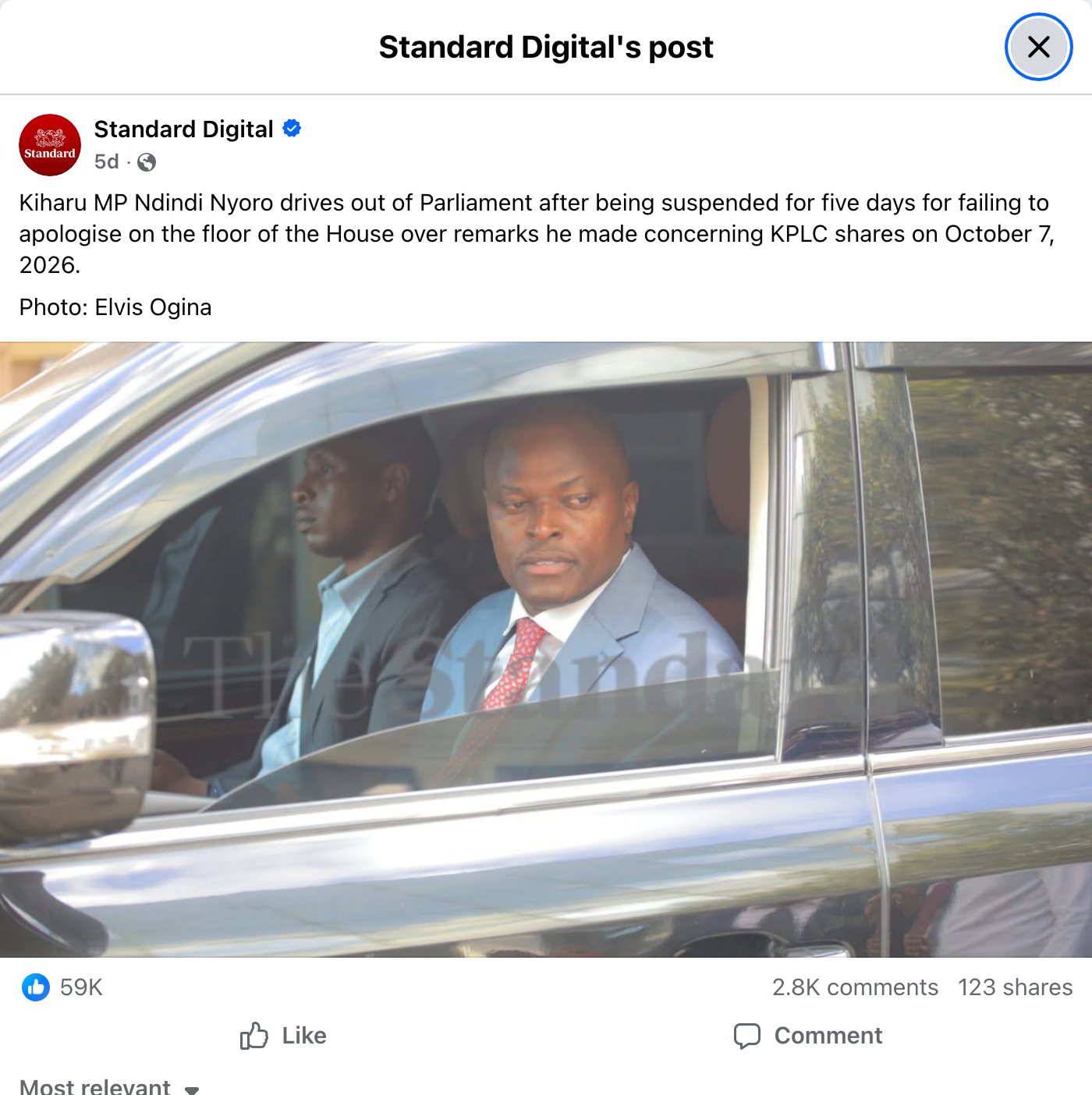
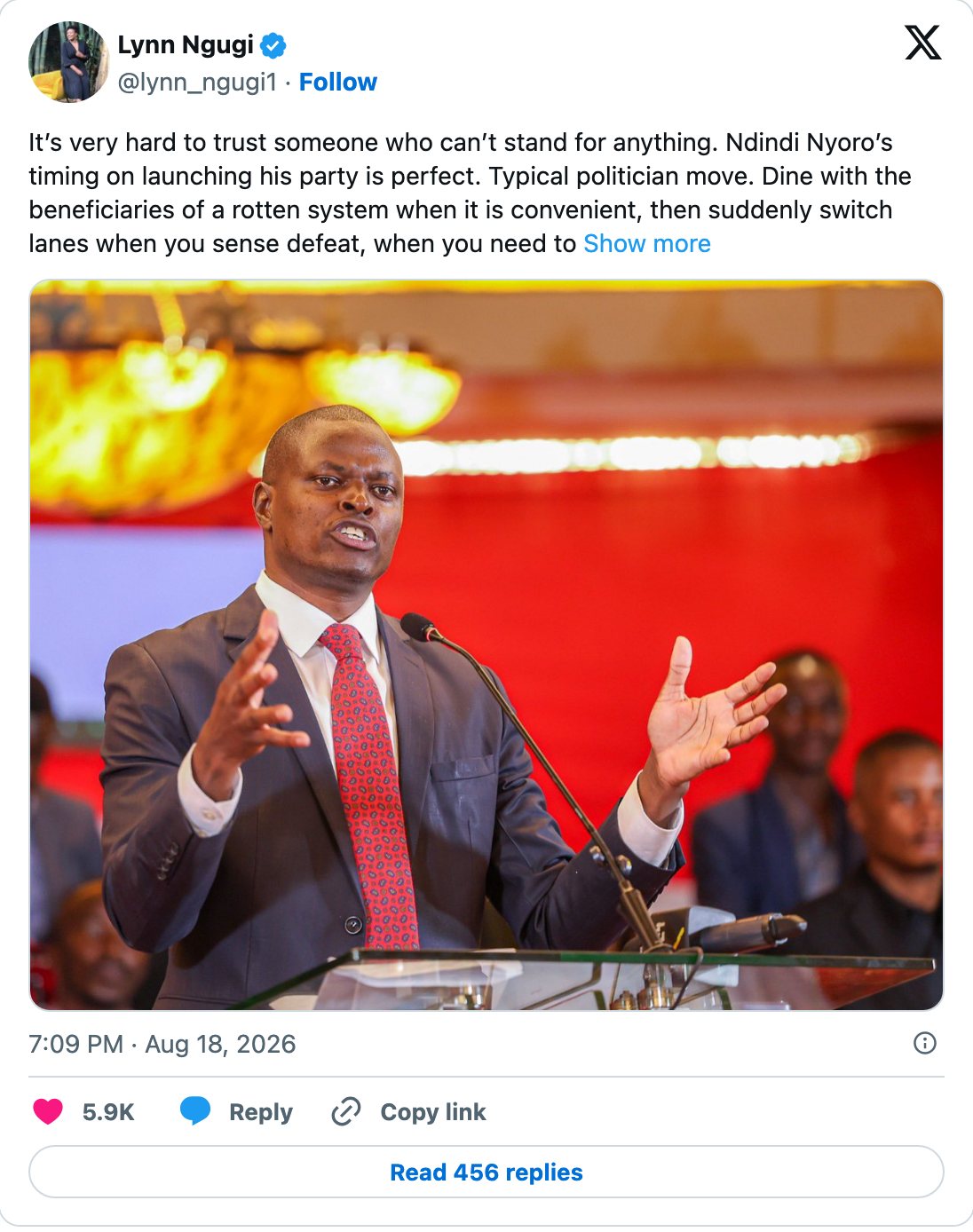
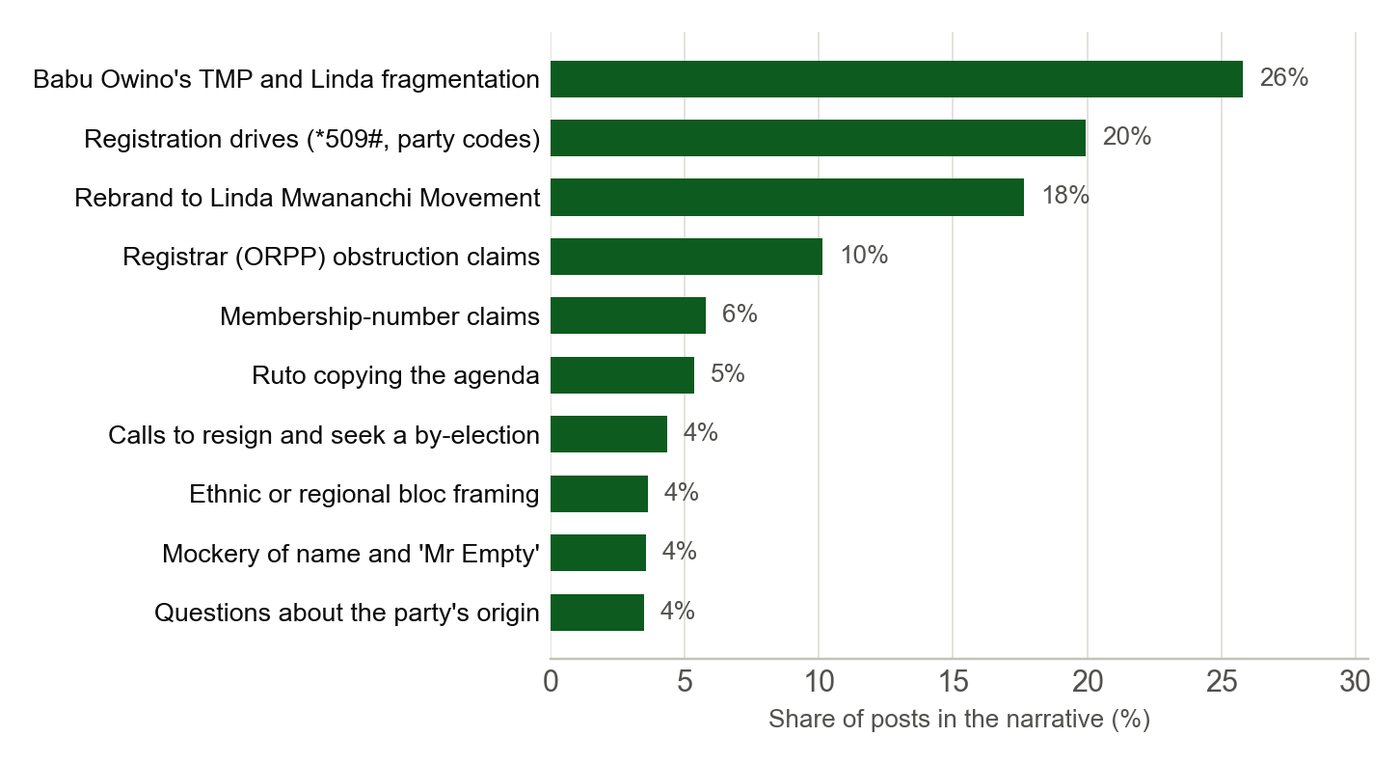
The most-liked and most-commented post about Nyoro since July is Standard Digital’s photograph of him driving out of Parliament on 7 October, after Speaker Moses Wetang’ula suspended him for five days (48,032 likes). The audience did not simply cheer: the top replies were “He thinks he is a hero” and “Drives out or driven out?”. Supporters pointed to police interrupting his events and the Kinangop confrontation; critics to his Finance Bill 2024 vote and his shares in Kenya Power. Journalist Lynn Ngugi wrote that it was “very hard to trust someone who can’t stand for anything” (5,947 likes). Ethnic or regional bloc language appears in 146 posts (4.6%).
A coordinated burst for a Matiang’i and Nyoro ticket (Finding 19)
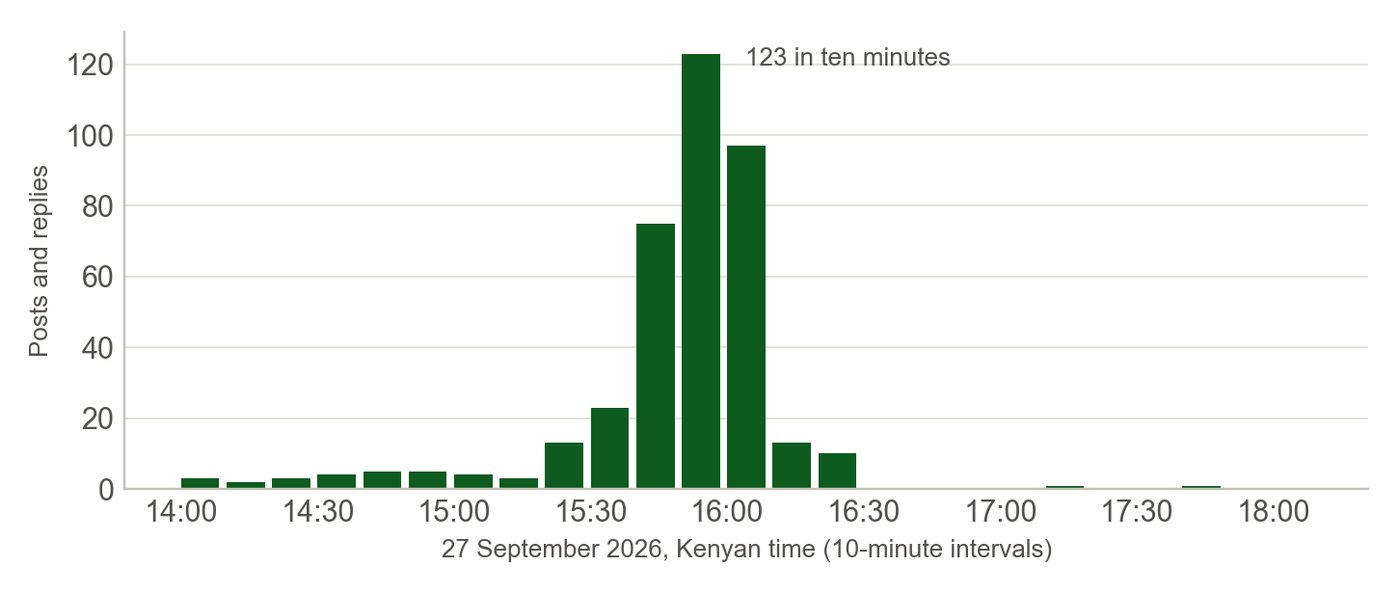
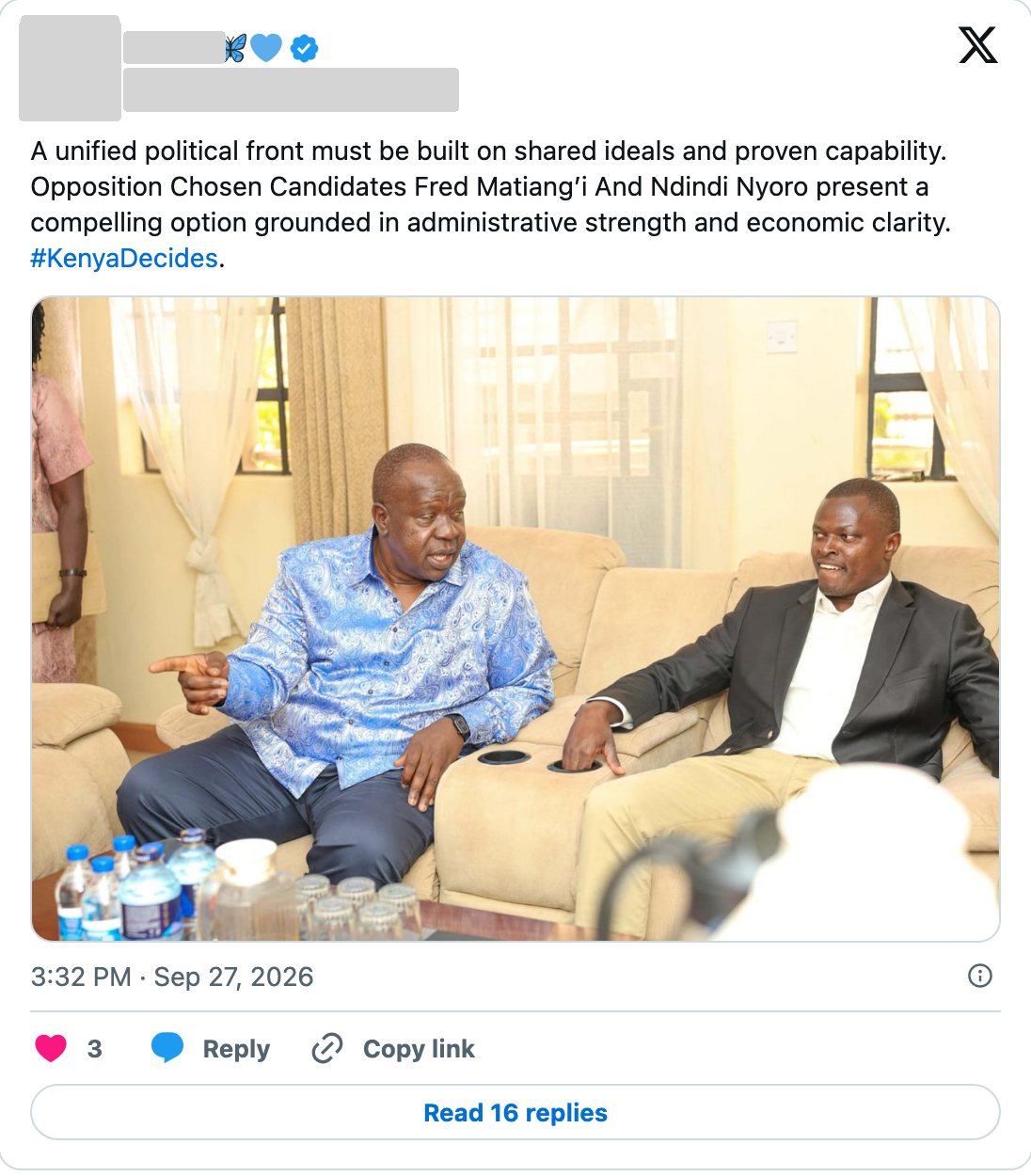
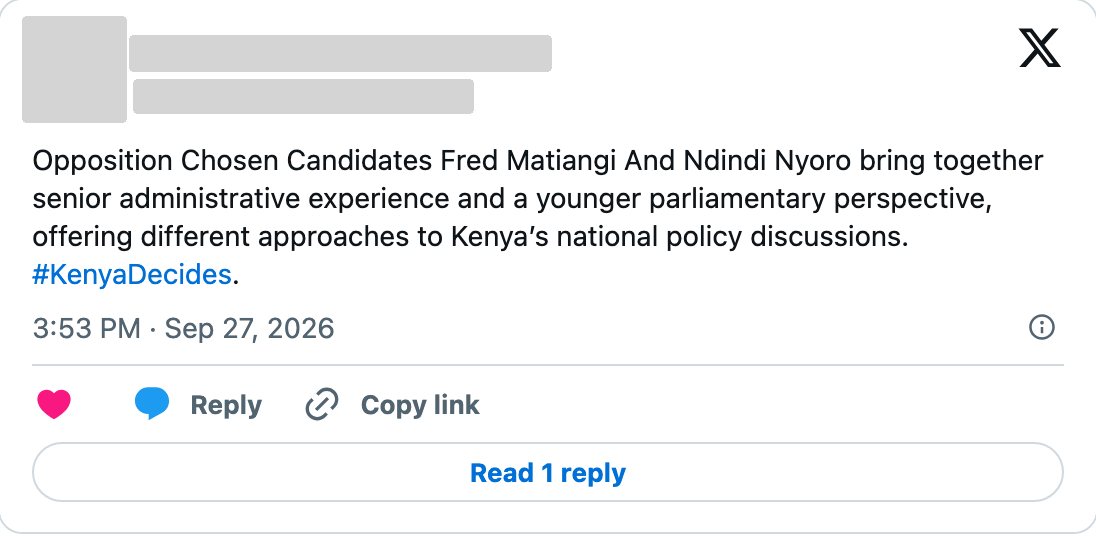
Between 14:03 and 17:41 on 27 September, 47 X accounts published 90 posts and 295 replies repeating “Opposition Chosen Candidates Fred Matiang’i And Ndindi Nyoro” with #KenyaDecides. Activity peaked at 123 items in ten minutes; every reply was posted under one of the group’s own posts, and 39 items repeated the same misspelling. One hundred items said the pair was “backed by Uhuru Kenyatta”.
The 385 items drew 70 likes between them, with a median of zero. Some accounts carry names unrelated to Kenyan politics, such as a Singapore ticket reseller and a technology tips page. By 13 October, posts from 15 of the accounts were no longer available. The data does not show who organised it or whether it was paid for.
What is coordinated amplification?
Many accounts posting the same or very similar content at the same time to make a message look more popular than it is. The signs, all present here, are identical wording, a tight time window, accounts replying to one another, and engagement close to zero.
Nyoro answers by attacking Ruto (Finding 20)
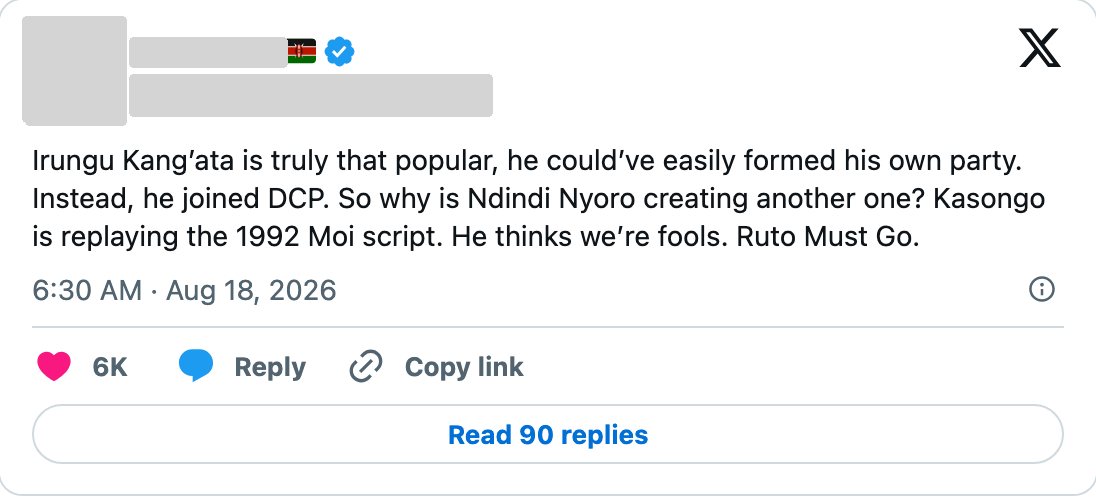
About one post in five in this narrative carries the claim that Nyoro is a government plant. A Facebook essay arguing he had worked against Gachagua drew 4,836 comments, Senator Karungo wa Thang’wa said he was being lined up as Ruto’s running mate, and posts recalled 1992, when a split opposition returned President Moi: “Kasongo is replaying the 1992 Moi script” (6,086 likes).
Nyoro answered by attacking the President over debt and the Dangote refinery deal, and pledged “I will send Ruto home” (18,542 likes). Ruto replied “hakuna shares za Dangote utapata wewe” (you will get no Dangote shares) (11,500 likes). His audiences were not persuaded: “This man is not honest!! He here to play spoiler!!”. Harmful comments were rarer here than anywhere else, at 2.5%.
357,000
likes on posts of Nyoro attacking Ruto
152,000
likes on posts carrying the ‘mole’ accusation
‘One million members in ten hours’ (Finding 21)
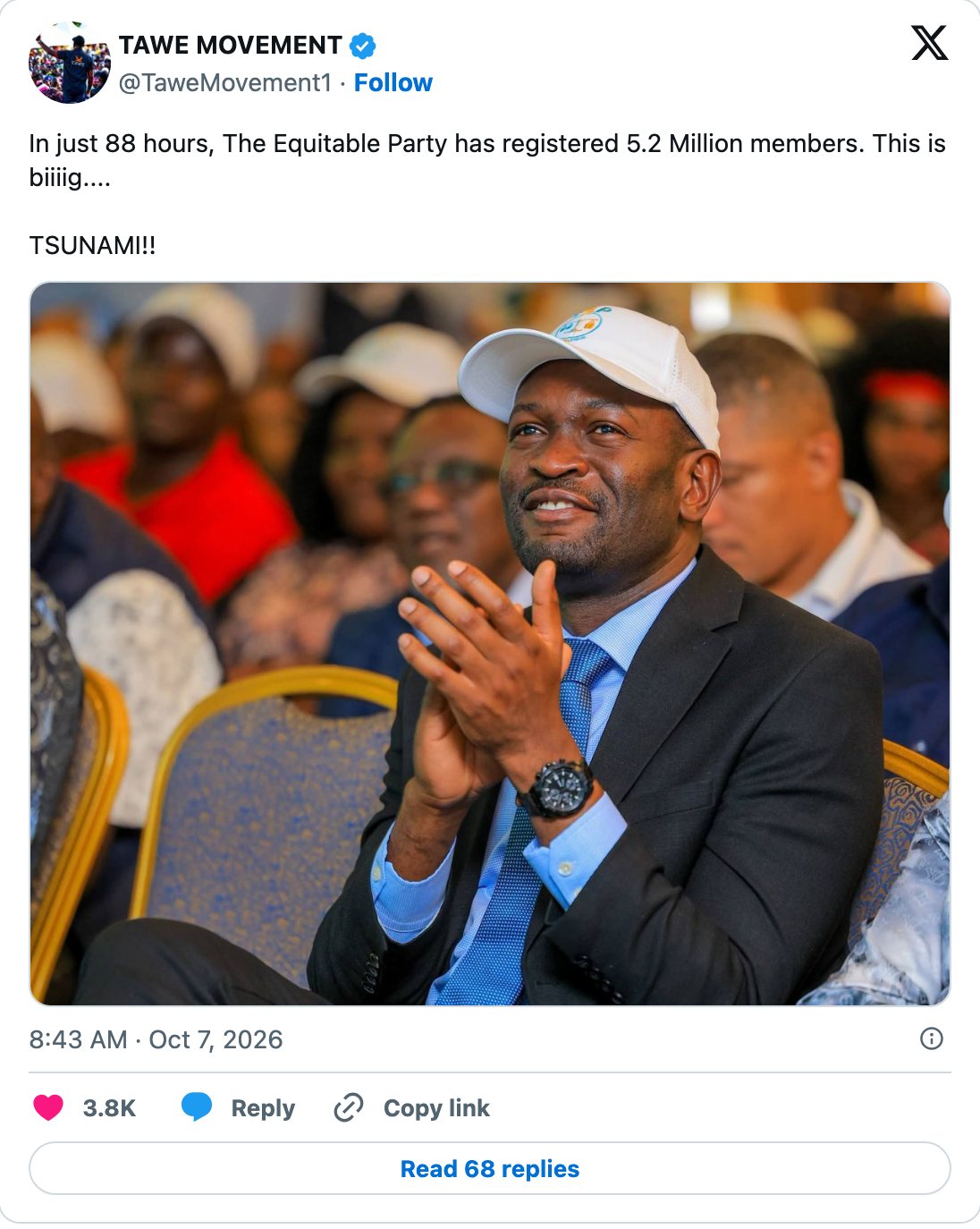
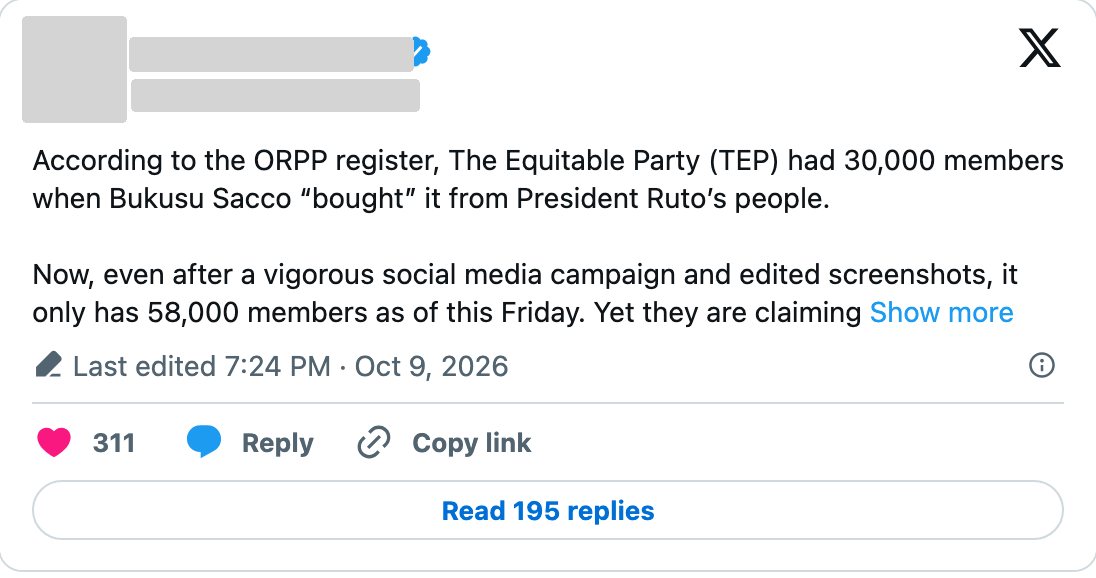
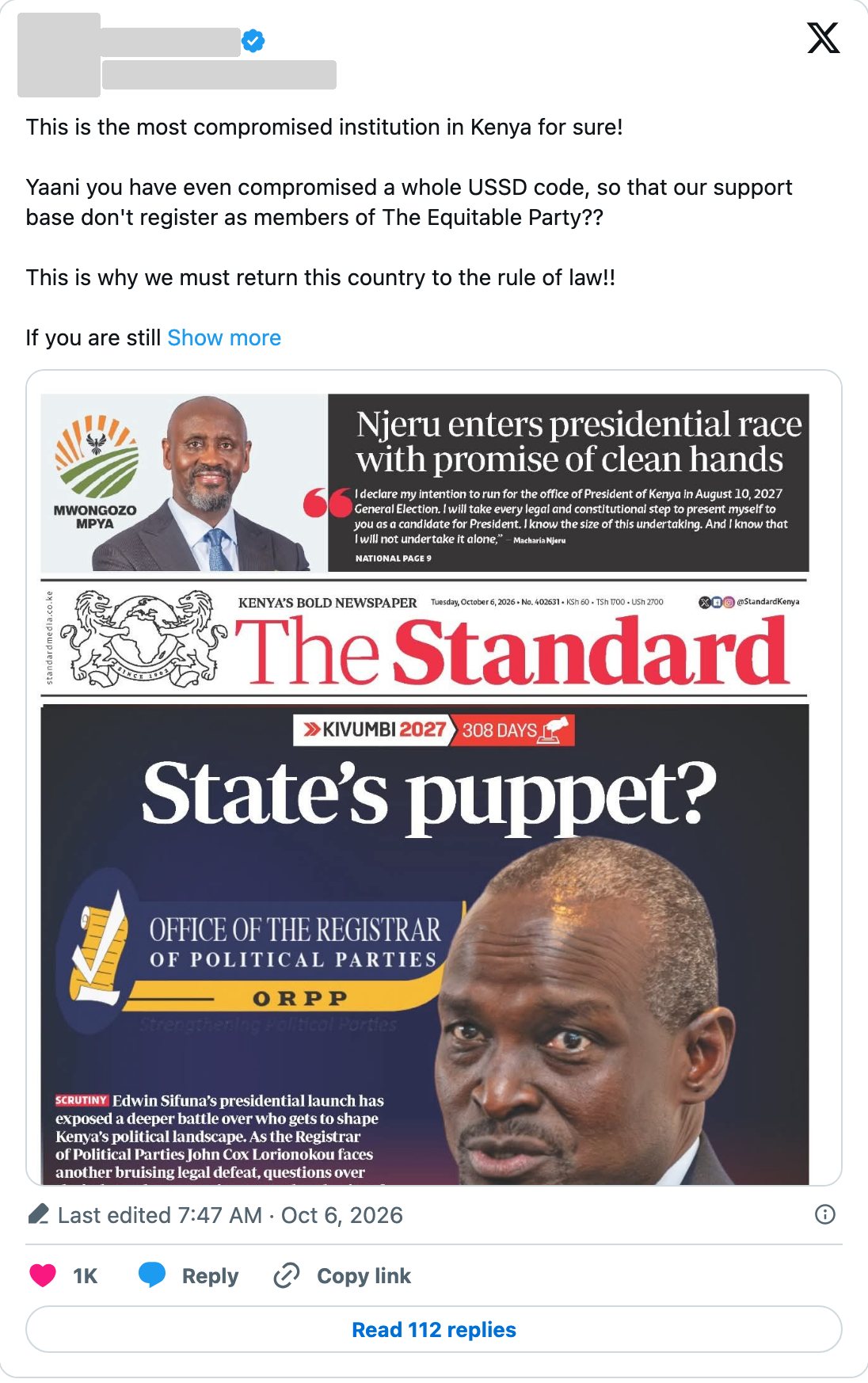
Within hours of TEP’s launch on 4 October, membership figures became the main way its success was argued. Sauti TV reported “over 1.1 million members in less than 10 hours”, adding that the registrar’s portal “confirms the massive surge” (41,400 likes). The figures escalated to six million in under a week, until Sifuna himself denied the five million claim on 9 October. A critic citing the registrar’s records put membership at 58,000 and accused supporters of “edited screenshots”.
When the *509# registration code failed, supporters blamed the registrar: a Sifuna supporter called it “the most compromised institution in Kenya”. Claims that the registrar was obstructing the party appear in 142 posts (10.2%). The registrar is an election-management body, and the same accusations transfer easily to the IEBC in 2027.
TEP membership figures circulated online, 4 to 9 October
None of these figures could be verified for this report (Source: Phoenix)
Swipe or scroll sideways to see all the posts. Tap a post to enlarge it.
‘Mr Empty’, a by-election and three origin stories (Finding 22)
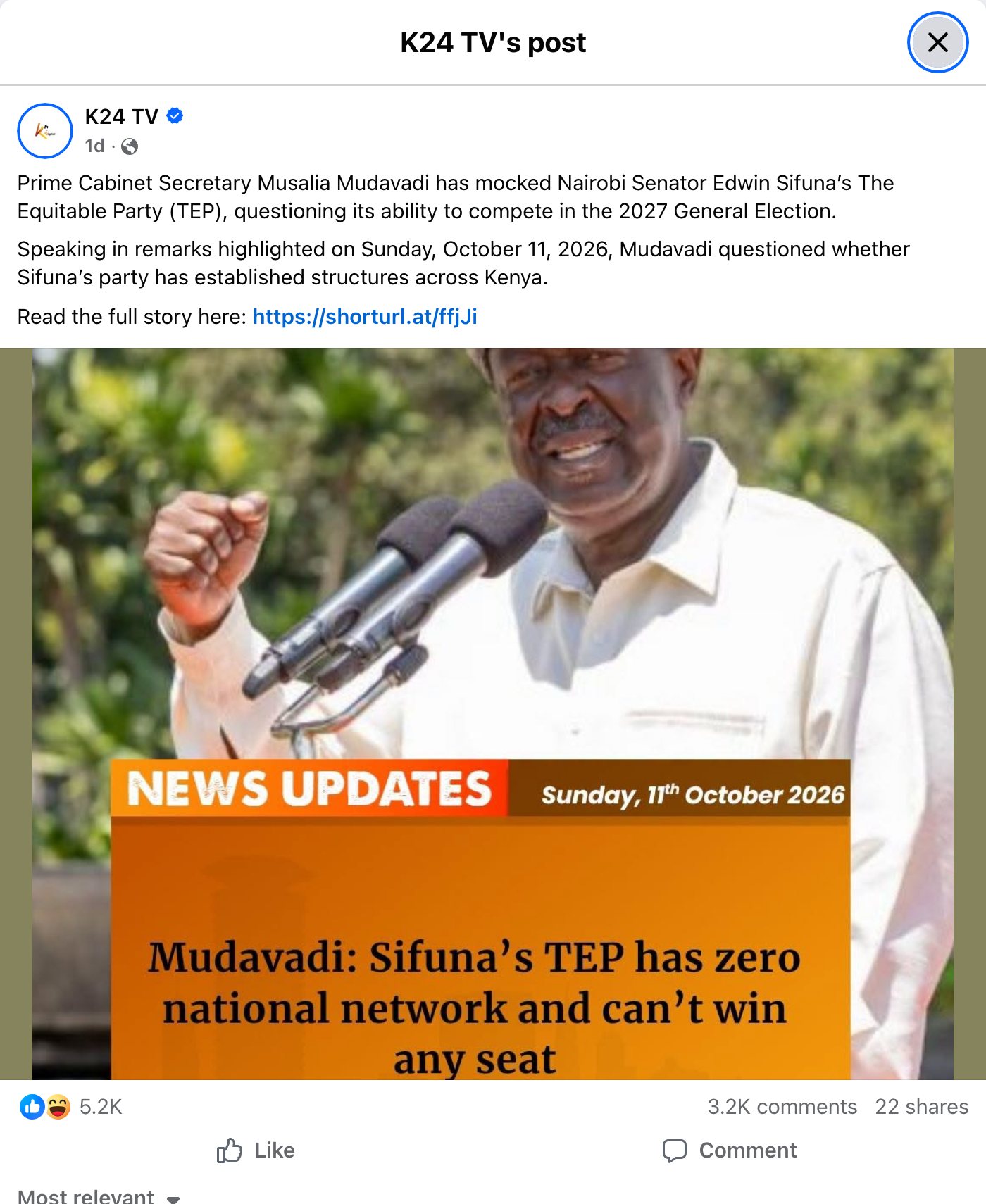
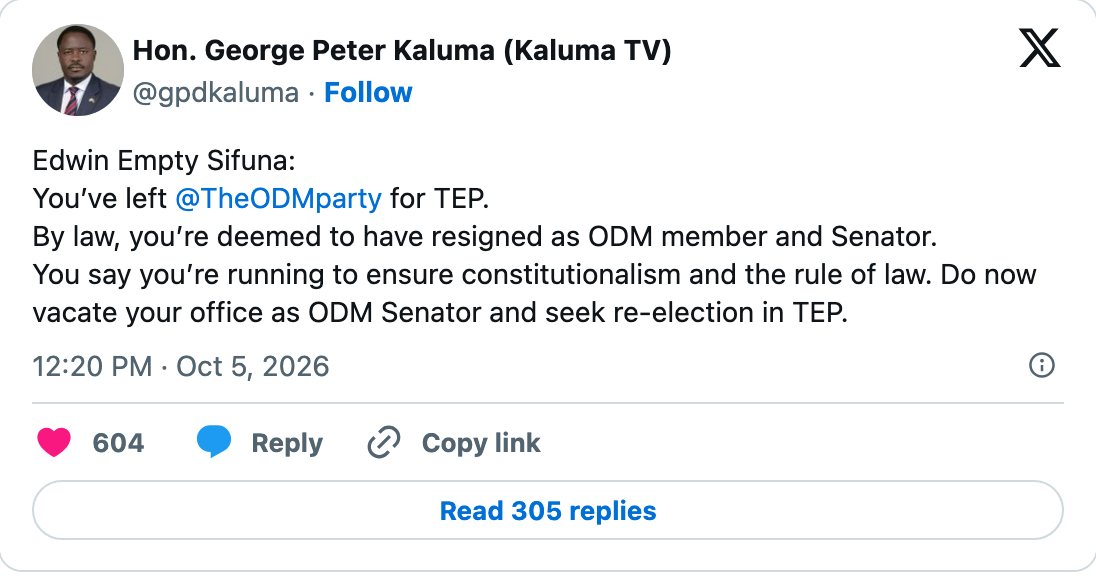
MP Peter Kaluma addressed Sifuna as “Edwin Empty Sifuna” and said he should resign his Senate seat and seek re-election under TEP (2,705 comments on TV47’s post). Prime Cabinet Secretary Musalia Mudavadi said TEP had “zero national network and can’t win any seat” (3,134 comments). In the comments these attacks mostly backfired: “Did Ruto resign from jubilee when forming uda?” (326 likes). Questions about where the party came from produced three incompatible stories, none with evidence:
Ruto’s allies
TEP belongs to President Ruto’s allies: registered in March 2022, it “pledged to support William Ruto” after the election.
Uhuru Kenyatta
Uhuru Kenyatta acquired it for Sifuna: registered in October 2025 as “The Economic Pillars Alliance” (486 comments).
A ‘Bukusu Sacco’
A ‘Bukusu Sacco’ bought it from Ruto’s people, a phrase that reduces the party to Sifuna’s sub-community.
A fragmented movement and an ethnic map (Finding 23)
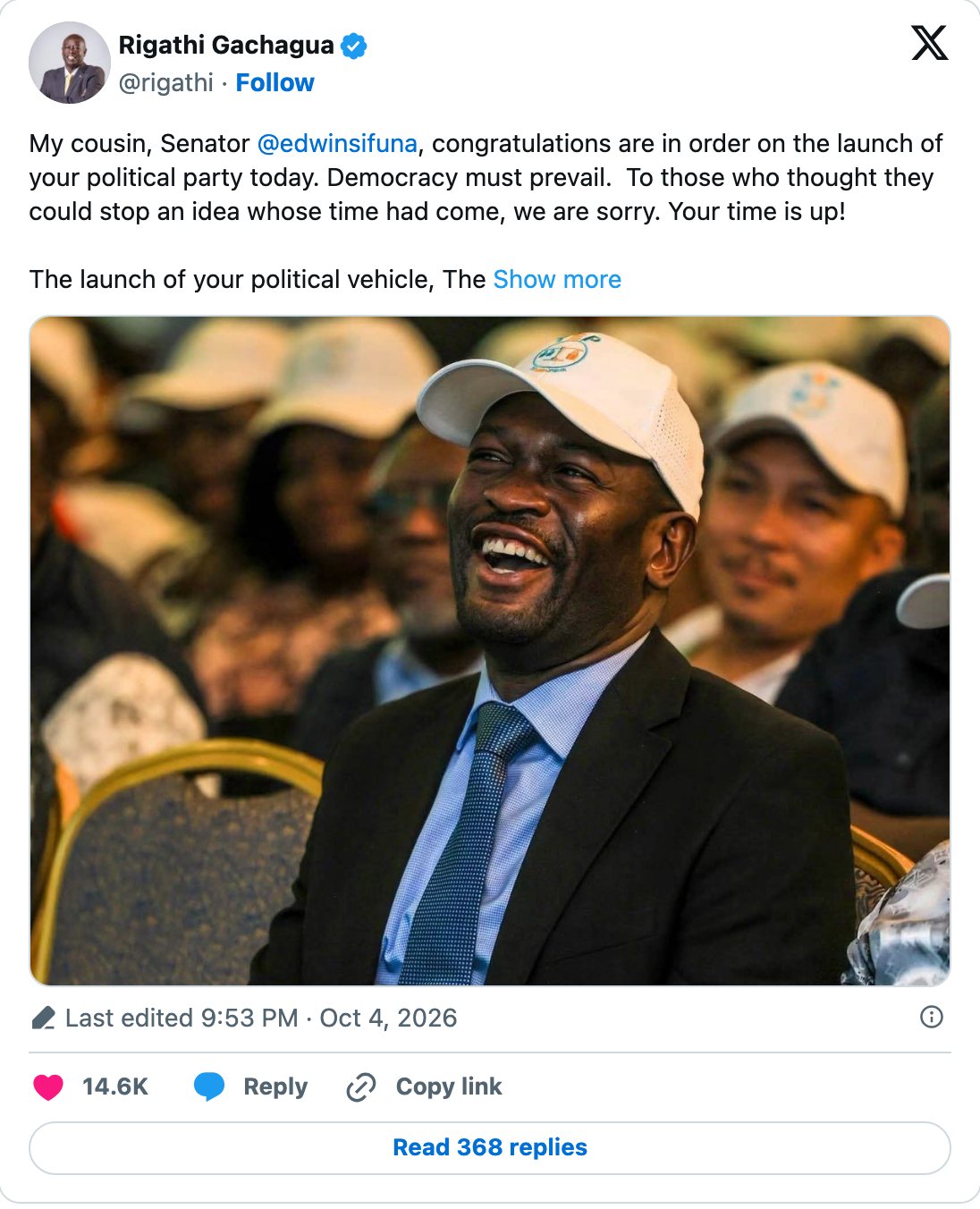
The single most-commented post in this report is Gachagua’s launch-day message: “My cousin, Senator Edwin Sifuna, congratulations are in order… Your time is up!” (83,599 likes and 7,041 comments on Facebook). Commenters noticed the contrast: “when Ndindi nyoro forms his … he’s a Mole? Okey”.
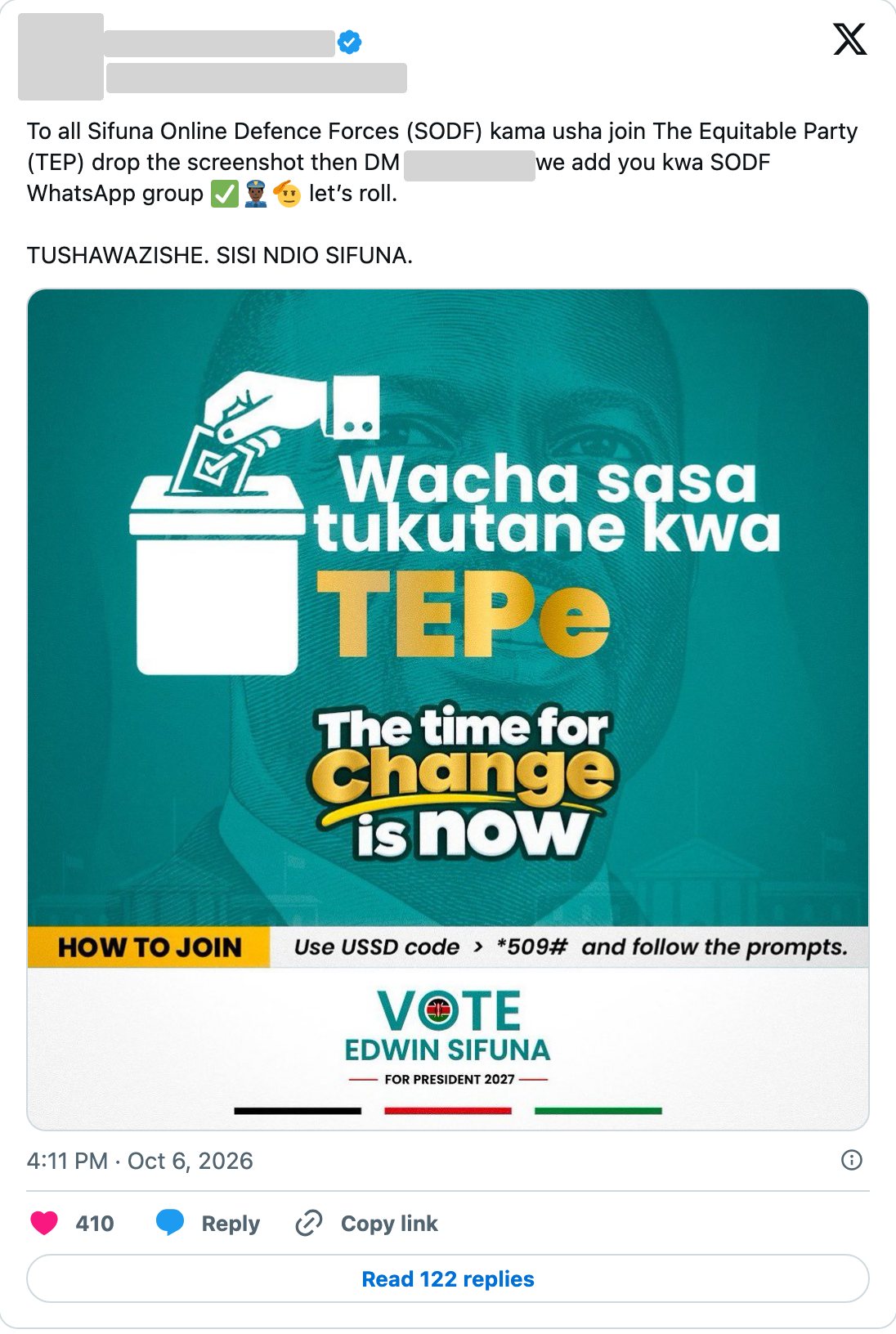
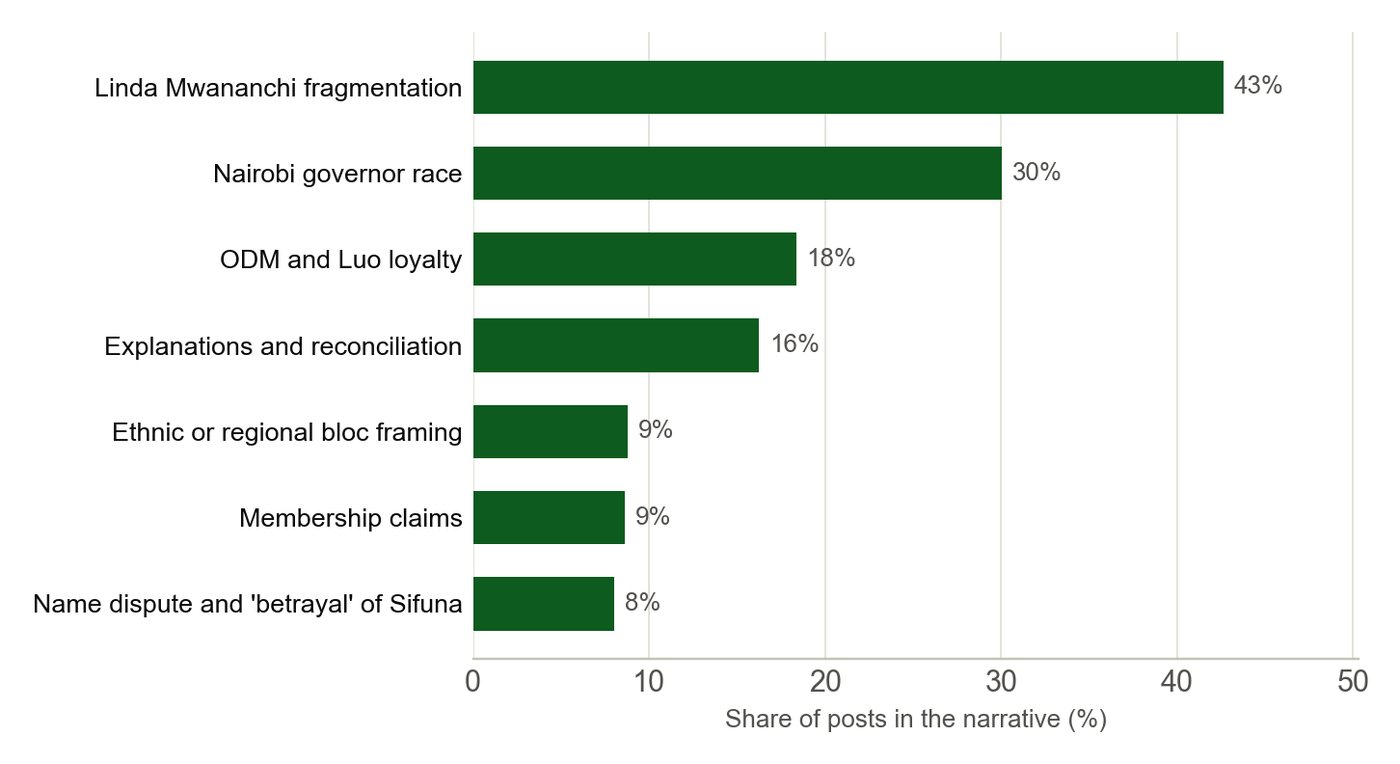
At the same moment, Linda Mwananchi’s leaders were in separate parties, and posts mapped each onto a county or community: “Babu’s TMP, Nairobi, Homa Bay and Migori; Orengo’s LDP, Siaya; Sifuna’s TEP, Bungoma”. Most of the conversation, though, was about mobilisation: daily registration drives, and a self-styled ‘Sifuna Online Defence Forces’ WhatsApp group.
Babu Owino’s party read as a betrayal (Finding 24)
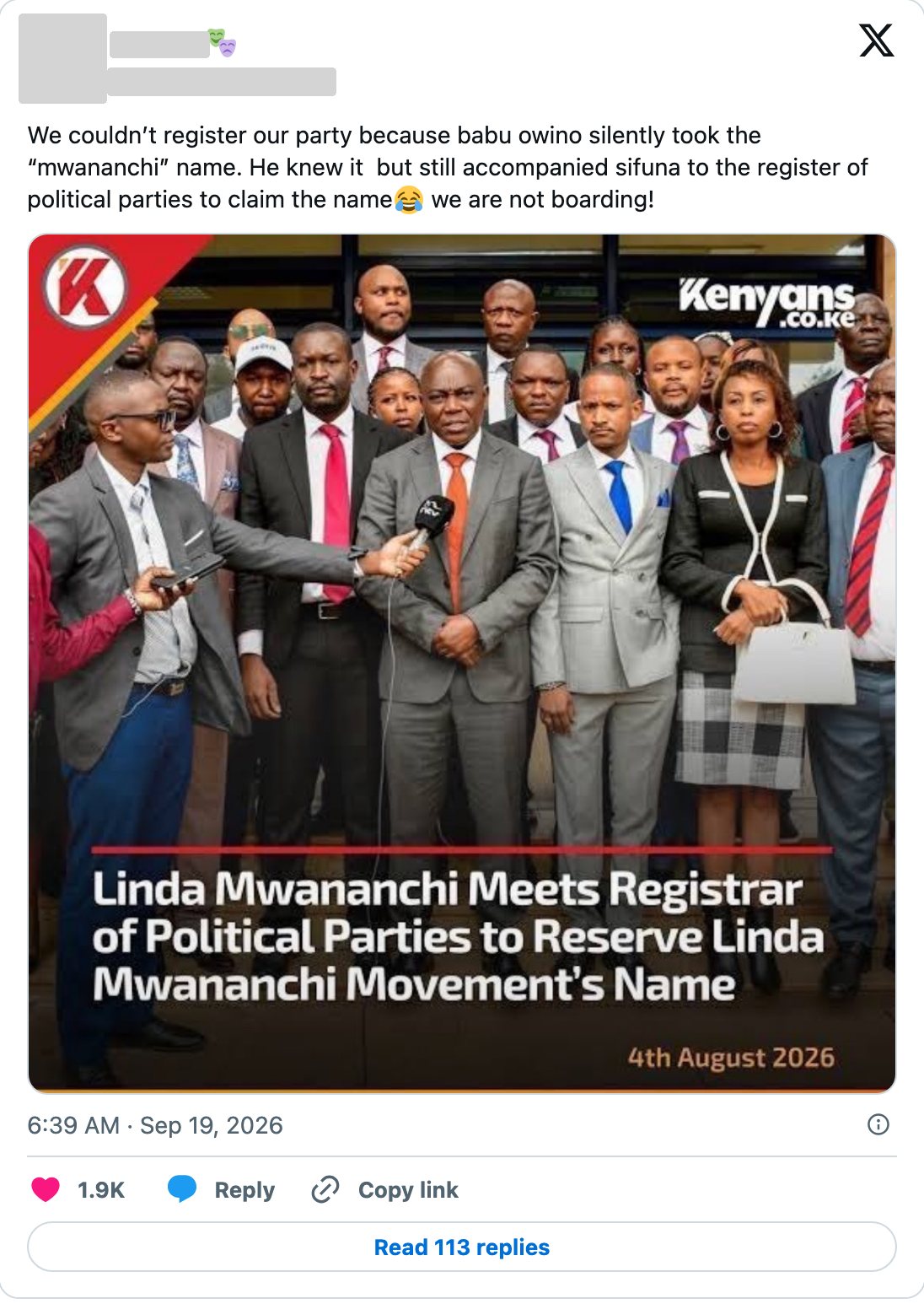
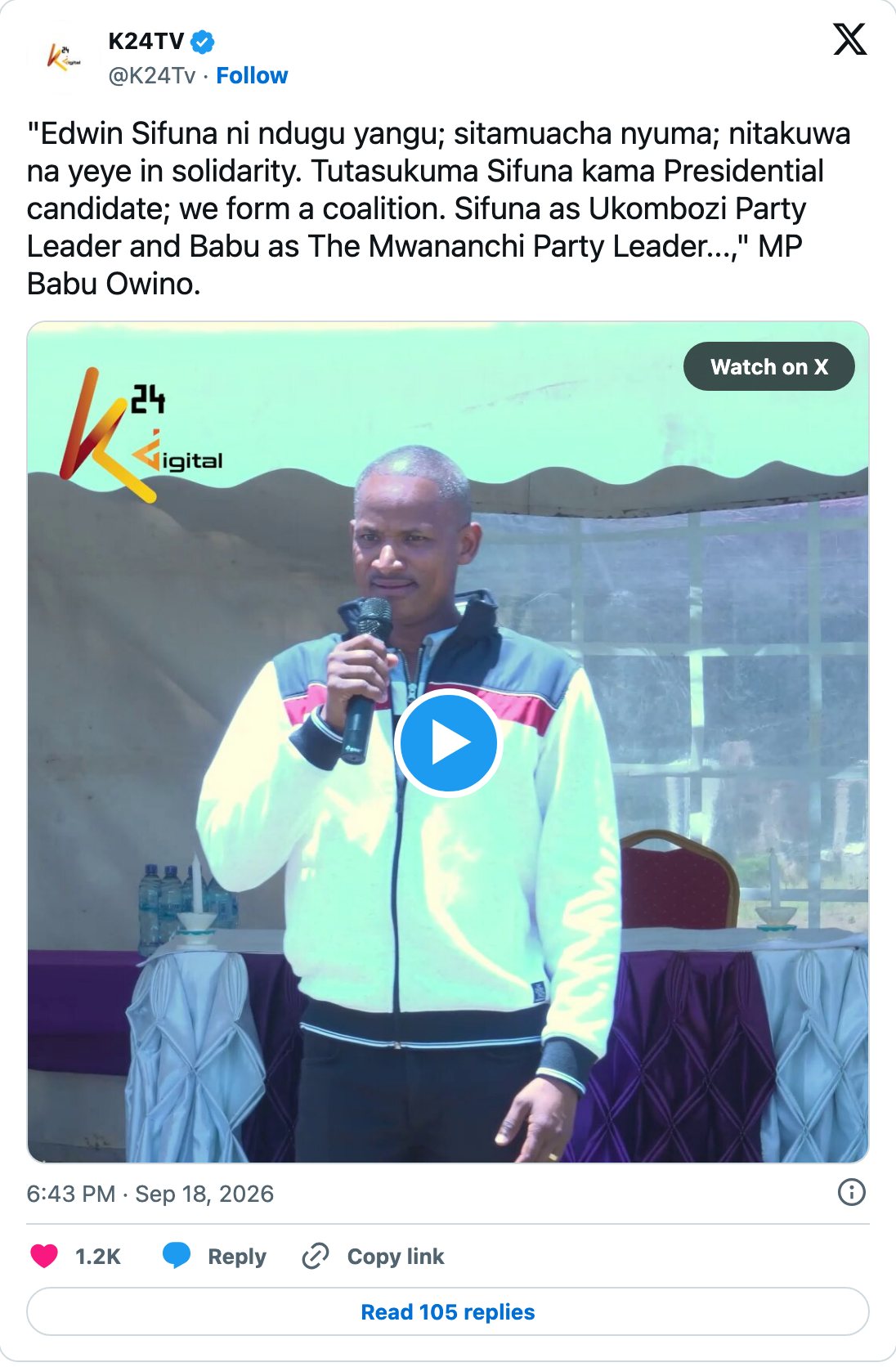
The Muungano Party was renamed The Mwananchi Party while Sifuna’s camp was still fighting for ‘Linda Mwananchi’. On 15 September Babu said “My focus is now on Nairobi!” (5,670 likes), and Sifuna’s supporters accused him of taking the ‘mwananchi’ name behind Sifuna’s back (1,918 likes). On 18 September Babu endorsed Sifuna: “Edwin Sifuna ni ndugu yangu; sitamuacha nyuma” (Edwin Sifuna is my brother; I will not leave him behind).
His bid for the Nairobi governorship drew ODM loyalists who questioned whether he was truly Luo, dismissing him as ‘Muhindi’ (Indian) or ‘Patel’, a jibe found in 177 comments.
Part 6 · Findings 25 to 28
Uhuru Kenyatta’s role
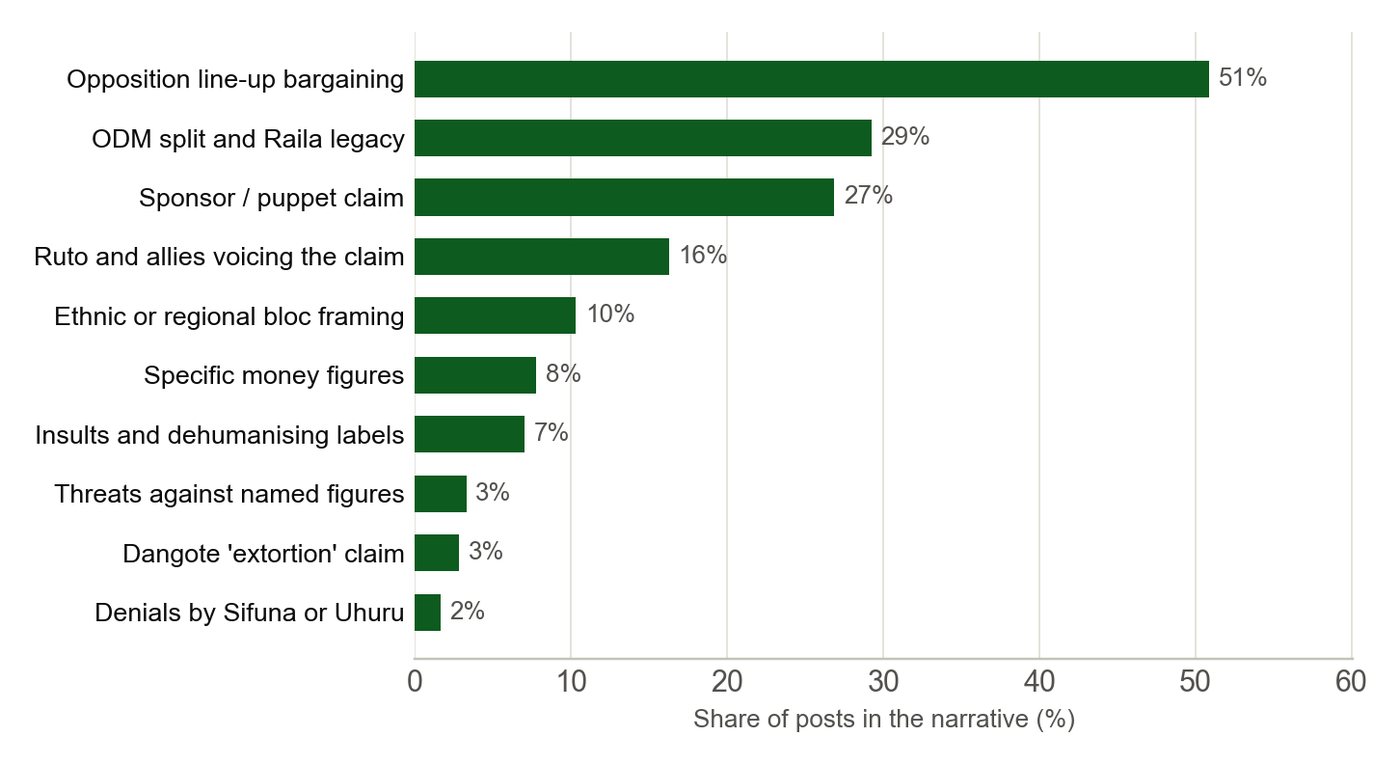
The narrative ‘Sifuna funded by Uhuru Kenyatta’ holds 1,095 posts with about 731,000 likes; about one in three makes a funding, control or ‘use’ claim. A second narrative, on Uhuru engaging in politics, holds 238 posts with about 301,000 likes.
‘The sponsor’ (Finding 25)
The claim was voiced most prominently by the President. In Homa Bay on 17 September he said “Stop using Sifuna to sabotage and undermine my administration”; on 1 October he accused Sifuna of being “sent by Uhuru to extort Dangote” (10,400 likes).
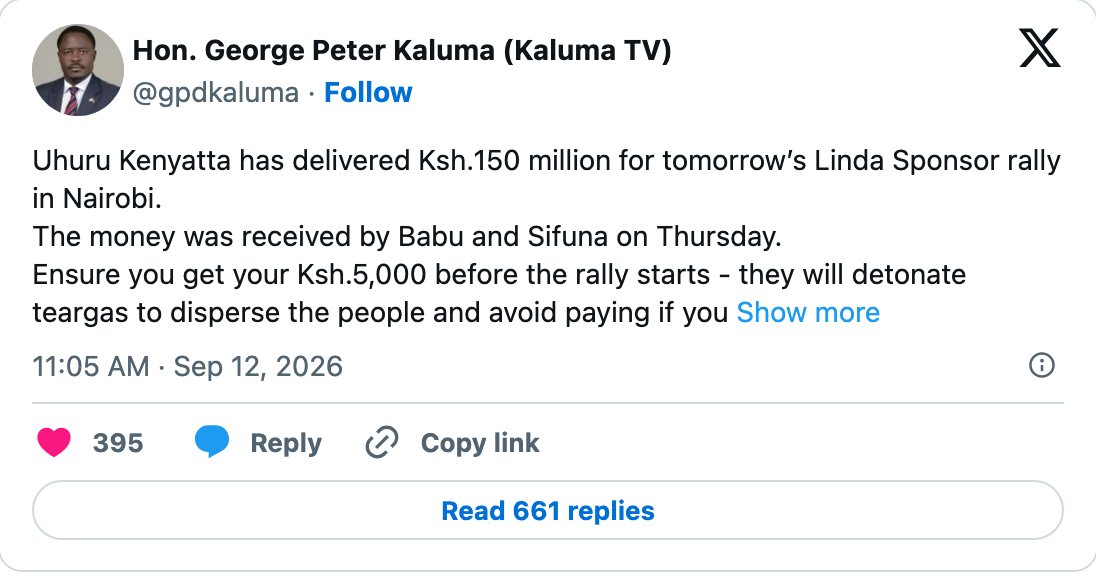
MP Peter Kaluma claimed Uhuru gave Sh100 million for the Homa Bay rally and later that he had “delivered Ksh.150 million” for a Nairobi rally (699 comments). Majority Leader Kimani Ichung’wah and Governor Wanga made similar claims, and Dennis Itumbi’s ‘Sponsor Chronicles’ series packaged them as a running story. No evidence was offered for any of the sums.
Swipe or scroll sideways to see all the posts. Tap a post to enlarge it.
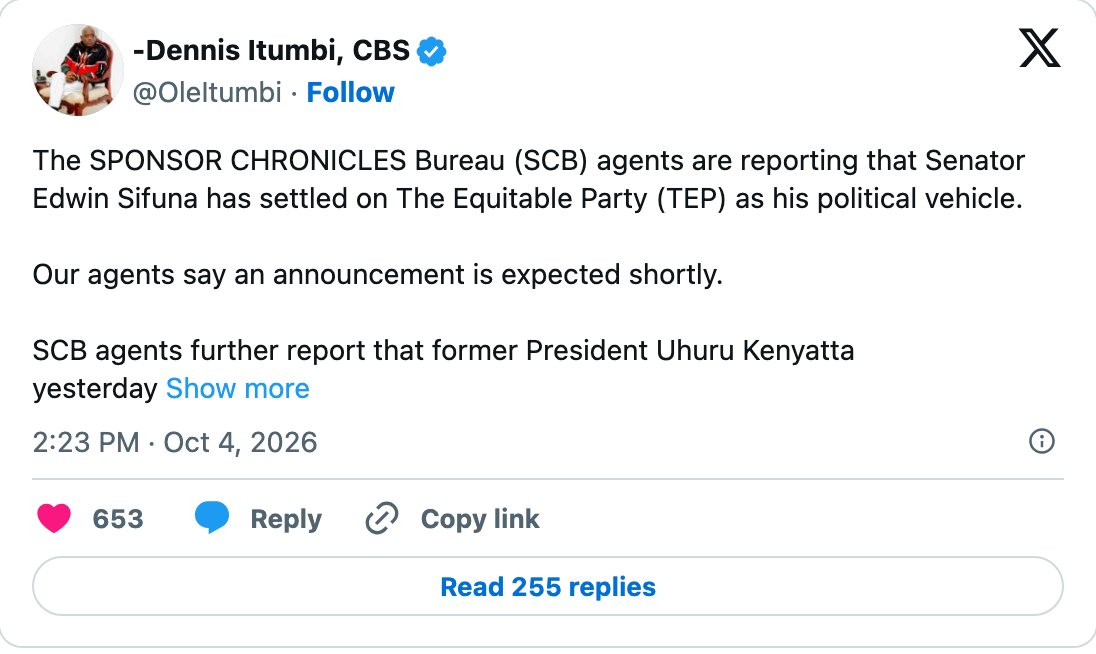
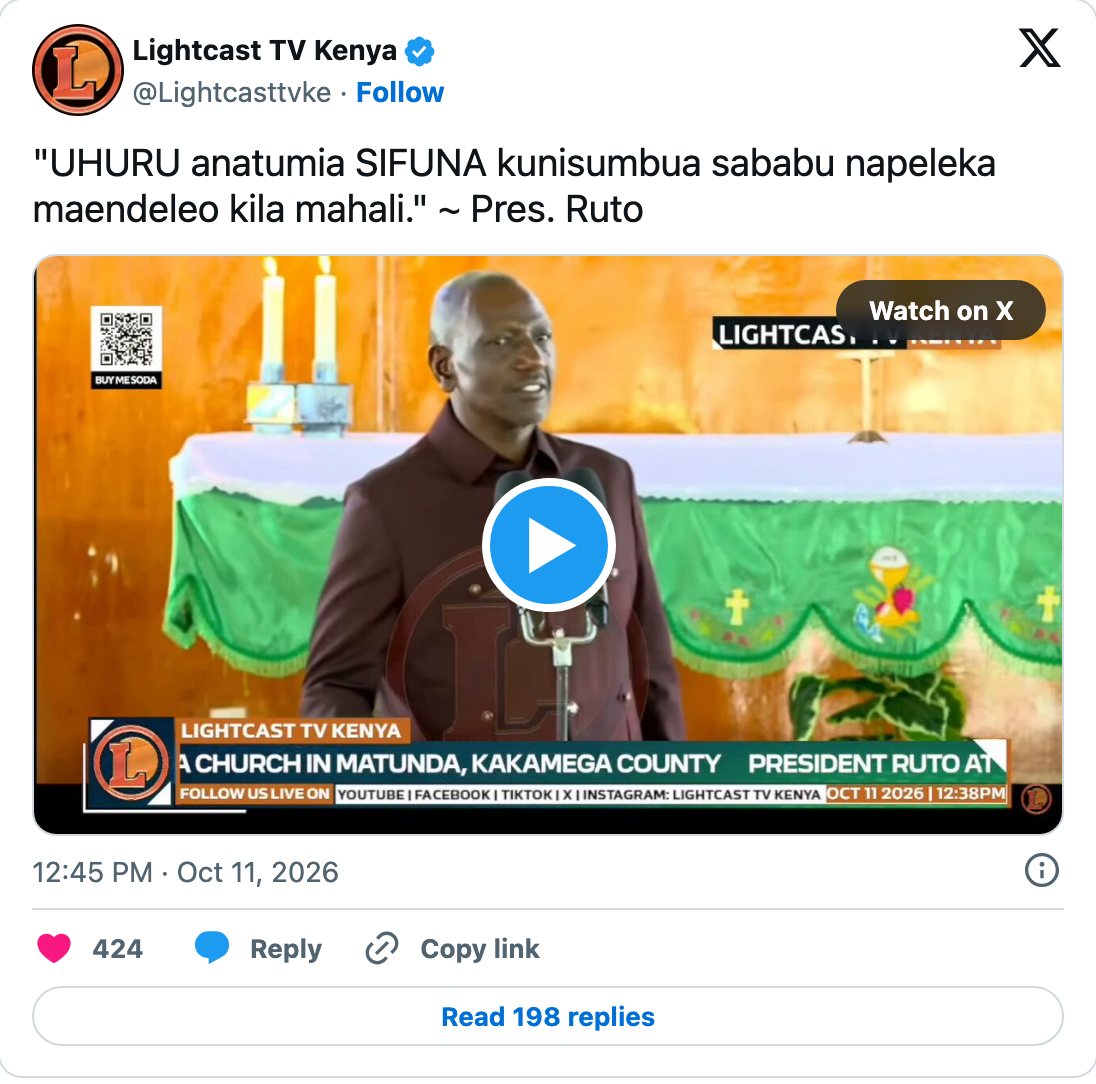
Denials travelled far less (Finding 26)
Both men rejected the label. Sifuna said “Yes, I do talk to Uhuru Kenyatta in private” but “Uhuru Kenyatta does not sponsor me”; in Kitale on 23 August Uhuru said “mimi sitaki kuitwa sponsor” (I do not want to be called a sponsor). That remark was itself shared as an endorsement of Sifuna (5,053 likes).
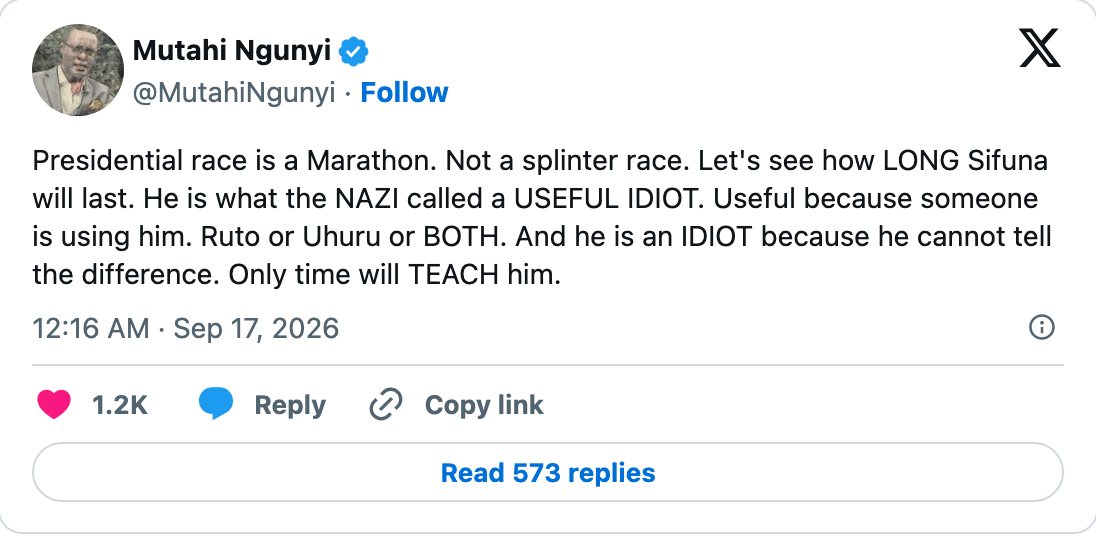
The claim also circulated in contradictory versions: that Ruto and Uhuru fund the movement together, and that Uhuru had dropped Sifuna for a Matiang’i and Nyoro ticket or for Kalonzo. Analyst Mutahi Ngunyi called Sifuna a “useful idiot… Ruto or Uhuru or both”.
294
posts making the funding or control claim
18
posts carrying a denial, about one for every sixteen claims
Swipe or scroll sideways to see all the posts. Tap a post to enlarge it.
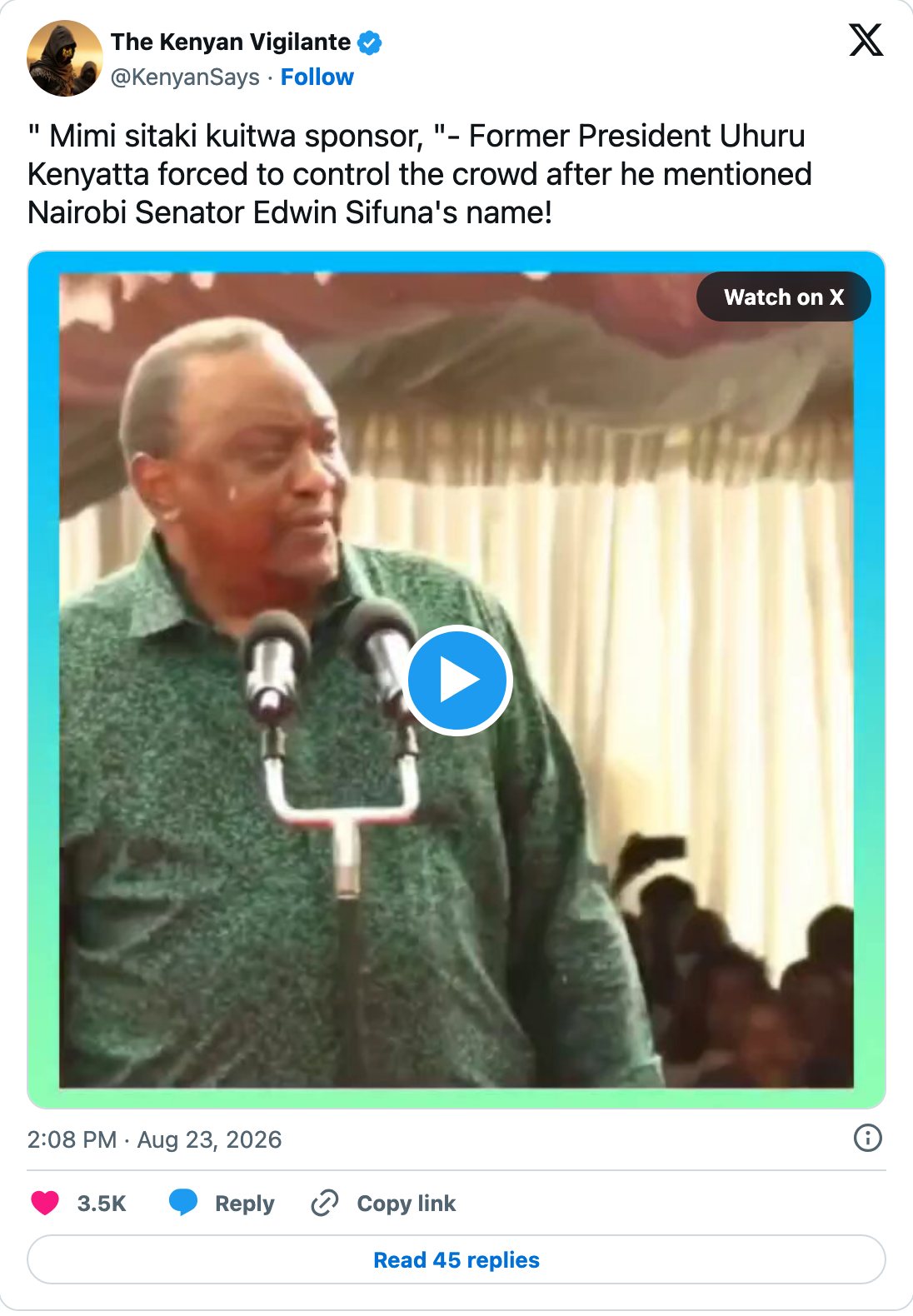
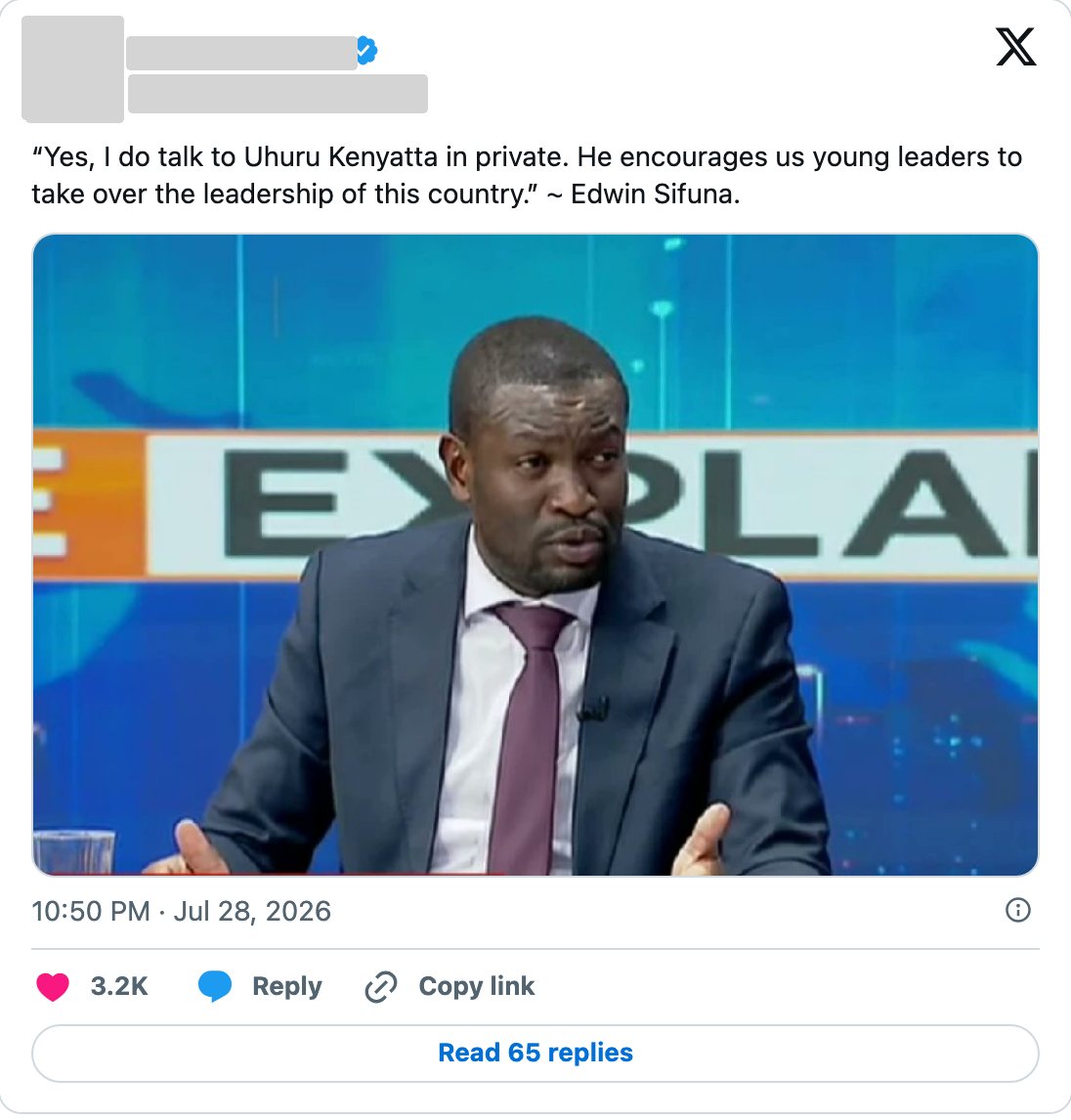
An ethnic plot, with threats (Finding 27)
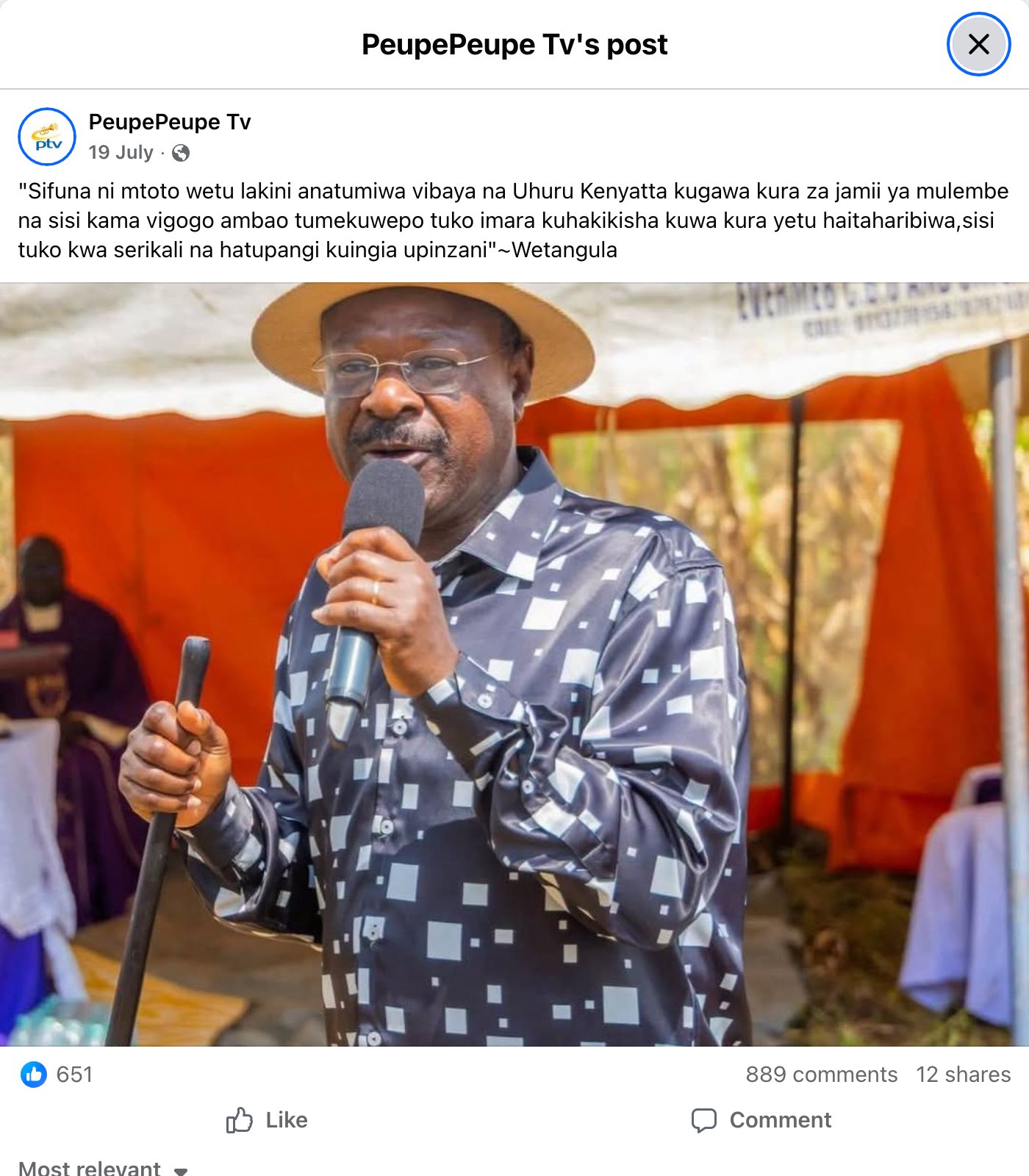
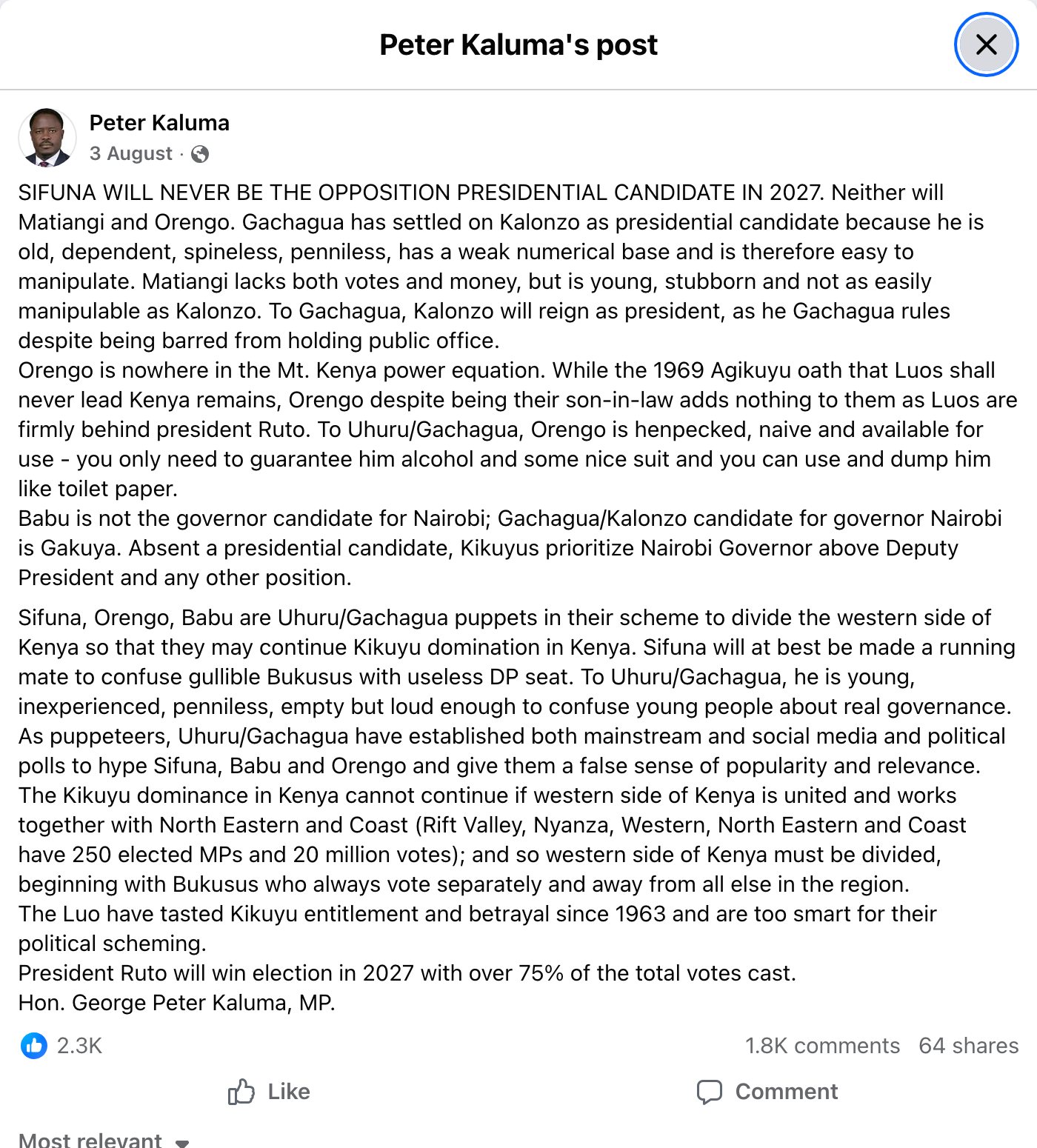
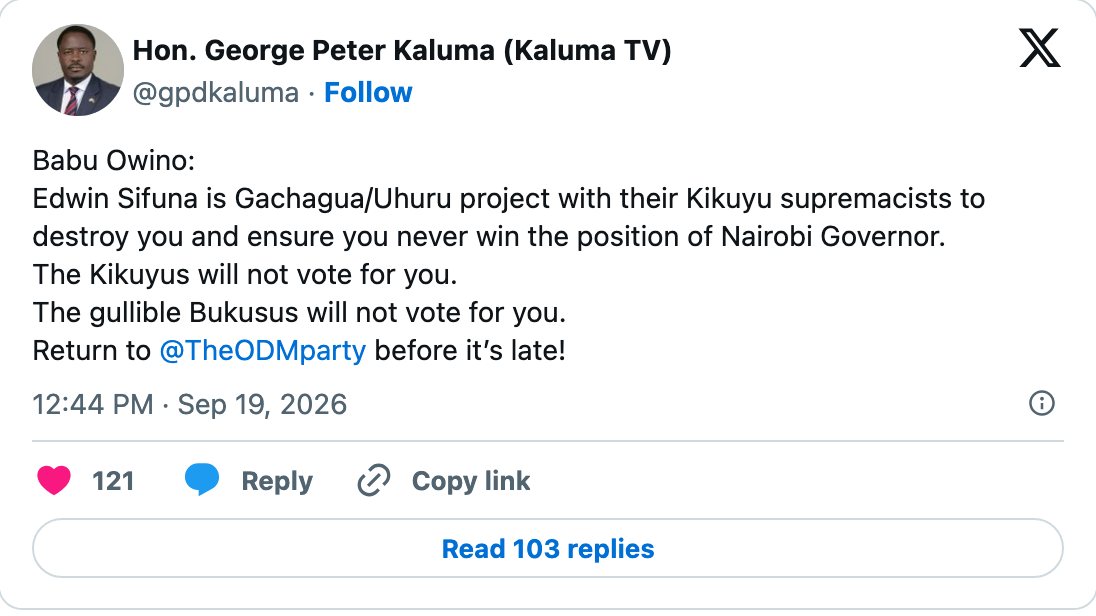
Speaker Moses Wetang’ula said Uhuru was misusing Sifuna “kugawa kura za jamii ya mulembe” (to split the Luhya vote) (889 comments). MP Peter Kaluma went furthest: in two long Facebook posts (1,779 and 1,771 comments) he wrote that a 1969 Kikuyu oath that Luos would never lead Kenya “remains”, and on X described Sifuna as a project of “Kikuyu supremacists”. These posts present a whole community as conspirators against another, and were shared by a sitting MP. The most-commented post in the narrative is a TikTok clip of MP Oscar Sudi warning Uhuru that if he kept sponsoring Sifuna “we will come for you” (2,225 comments). Ethnic or regional bloc language appears in 10.3% of posts in the narrative.
Their audiences largely rejected these claims: “sudi, Kenya NI ya kila mtu, if sifuna is sponsored, then sponsor your own person” (520 likes), and on TikTok, “AM FROM MURIMA AND SIFUNA IS WHAT KENYA NEEDS” (744 likes). The ‘mole’ claim against Nyoro was largely accepted by the audiences it was aimed at; the ‘sponsor’ claim was largely rejected by its own.
Swipe or scroll sideways to see all the posts. Tap a post to enlarge it.
Uhuru turns ‘sponyo’ into a joke (Finding 28)
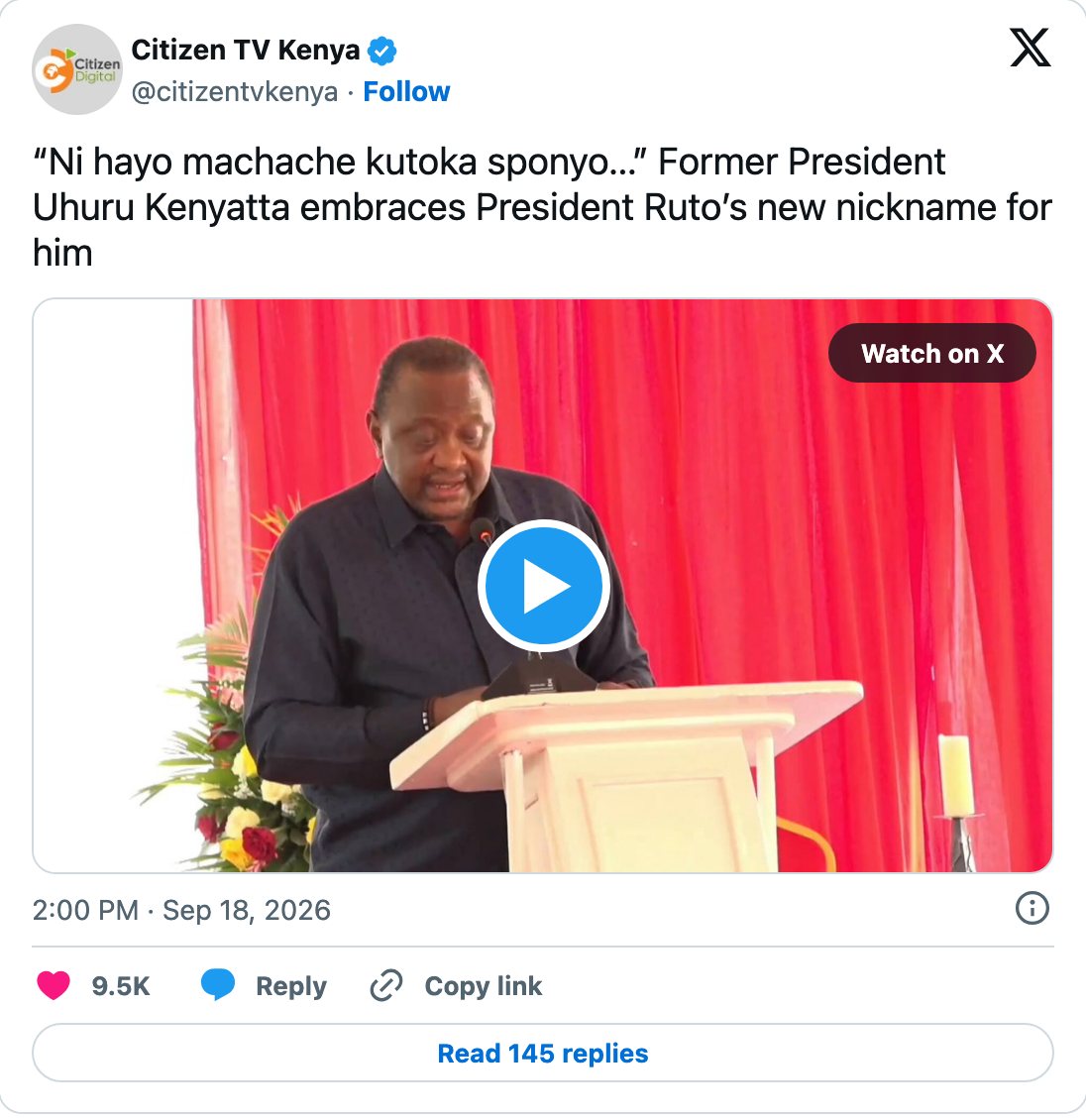
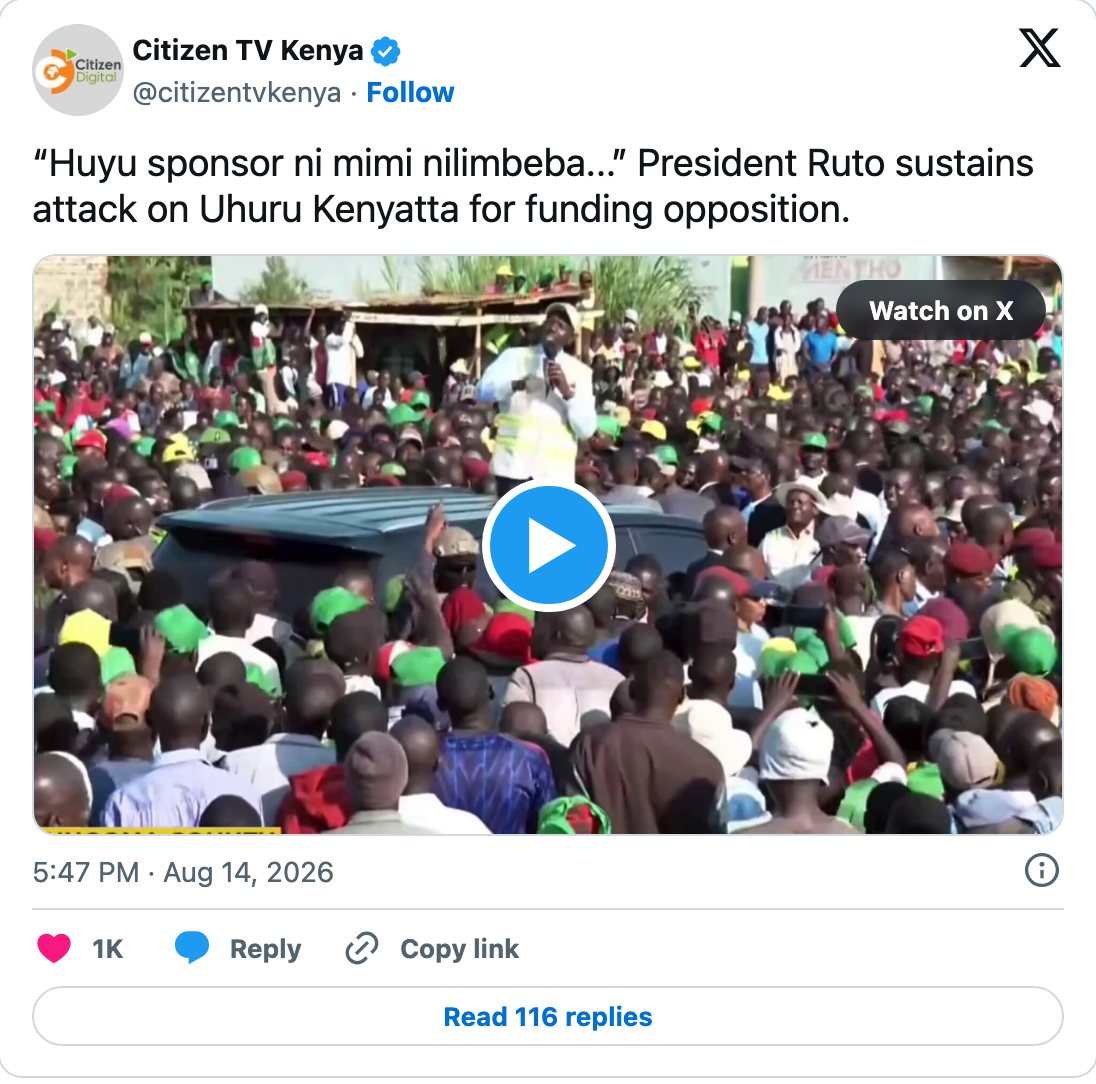
Ruto’s attacks set the terms: “Huyu sponsor ni mimi nilimbeba” (this sponsor, I am the one who carried him). Uhuru answered with a joke, closing a condolence message in Kiharu on 18 September with “Ni hayo machache kutoka sponyo” (that is all from the sponsor), and a TikTok clip of him accepting the label drew 52,600 likes. Posts carrying his replies drew 115,000 likes, more than three times the 33,000 on posts reporting Ruto’s attacks.
The argument then moved to the courts. In mid-September the High Court ruled that a retired president may not hold party office, and Uhuru handed the Jubilee leadership to Fred Matiang’i; on 21 September a further ruling declared it unconstitutional to bar retired presidents from politics. On 5 October he stepped down as chair of the Azimio coalition council, now The Ukombozi Alliance.
Timeline
Key events, July to early October 2026
As reported in the posts collected for this analysis.
5 July
Nyoro exits UDA
19 July
Wetang’ula: Sifuna ‘misused’ by Uhuru to split the Luhya vote
29 July
Claim: ‘IEBC: No live streaming’; denied the next day
8 August
Kaluma warns against ‘one term’ chants in Homa Bay
16 August
Violence at the Linda Mwananchi rally in Homa Bay
17 August
Nyoro launches the People’s Party of Kenya (PPK)
18 August
NCIC summons MP Peter Kaluma
23 August
Uhuru in Kitale: ‘I don’t want to be called sponsor’
26 August
Gachagua: technology tender favours Miru Systems
30 August
MP Wainaina ‘not apologetic’ about Kikuyus leaving Eldoret; Oburu Oginga admitted to hospital
2 September
Directive on foreign traders; Burundians harassed
6 September
KTN and The Standard report on Homa Bay
9 September
Man charged with hate speech over Burundians
11 September
Hassan Omar’s ‘dead voters’ remark
12 September
Violence at Kindiki’s UDA meeting in Embu
15 September
Babu Owino: ‘My focus is now on Nairobi’
18 September
Uhuru in Kiharu: ‘Ni hayo machache kutoka sponyo’
19 September
Old audit figures on dead voters posted as new
20 September
Nyoro and MP Thuku clash at a Kinangop church
21 and 22 September
High Court: retired presidents may take part in politics; the national tallying centre stays
24 September
Eldoret lecturer clip: ‘do not come back’
27 September
#KenyaDecides burst: 385 items in four hours
1 October
NCIC determination on Kaluma and Otuoma; Ruto: Sifuna sent by Uhuru to ‘extort’ Dangote
4 October
Sifuna launches The Equitable Party (TEP)
6 October
First Ebola case, and claims it was invented; Kaluma: remove ‘fake Kikuyu voters’
7 October
Oburu death rumours, denied by ODM; Nyoro suspended from Parliament
8 October
Alleged Homa Bay gang leader arrested
How we did this
Data and method
The analysis used Phoenix, a social media monitoring tool, with Boolean keyword searches for each narrative on Facebook, TikTok, X and YouTube. It covers content in English, Kiswahili and Sheng, with some posts in Gikuyu, Dholuo, Luhya, Kamba and other languages, published between 1 July and 13 October 2026.
The twelve narratives are based on 9,034 posts, which had drawn about 7 million likes and ~424,000 comments when collected. About 210,000 of those comments were also reviewed: ~105,600 from Facebook, ~64,000 from TikTok, ~36,200 from YouTube and ~3,800 replies and quotes from X.
A random sample of comments was hand-read for each narrative (300 each for three narratives, 200 for the other nine), which gives the share of harmful comments with a margin of error. Separately, a keyword screen in English, Kiswahili and Sheng picked out 1,894 comments likely to contain violence, threats, ethnic slurs or dehumanising language, which were read and classified as hate speech, incitement, threats, harassment, gendered abuse or mis/disinformation. The 295 templated #KenyaDecides replies and 282 scam messages were excluded.
The data covers public content only, and misses private accounts and closed spaces such as WhatsApp groups, where much campaign content circulates. Keyword searches can miss posts that use other words, slang or coded language. About half of the comments reported on these posts were collected, concentrated on the most-discussed posts, and the people who comment publicly are likely to be younger, more urban and more politically engaged than voters as a whole.
Older posts are less likely to be retrieved, so differences between months should not be read as trends. Engagement figures are those at collection. Severe-content figures are a floor, not a total.
Posts by politicians, public institutions, media and other prominent public accounts are shown as published. For accounts of private individuals, names, handles and profile pictures are hidden in screenshots and the accounts are not named in the text. Hateful comments are described rather than repeated.
Azimio, Ukombozi Alliance: the opposition coalition formed for the 2022 election, renamed in 2026. Bomas: the site of the national tallying centre. DCP: Democracy for the Citizens Party, led by Rigathi Gachagua. Kasongo: a nickname used by critics for President Ruto. Linda Mwananchi: ‘Protect the Citizen’, the movement led by Sifuna and Babu Owino. Mulembe: the Luhya community. Murima, Mlima: the Mount Kenya region. ORPP: Office of the Registrar of Political Parties. PPDT: Political Parties Disputes Tribunal. Sponyo: ‘sponsor’, a label for Uhuru Kenyatta. Wantam, Tutam: ‘one term’ and ‘two terms’ for President Ruto.
Read the full report
Download the complete analysis as a PDF, with all 28 findings, every narrative in full, the glossary and the method.
Keep reading
Other stories you might like
Special reports
How the NCIC is discussed online
Social media analysis · Special report How the NCIC is discussed online Kenya’s cohesion commission was in the news almost every week between May…
Read more
Special reports
How the IEBC is discussed online
Social media analysis · Special report How the IEBC is discussed online Most posts about Kenya’s electoral commission simply reported what it was doing.…
Read more
Special reports
Anti-Burundian xenophobia narratives in Kenya
Social media analysis · Special report Anti-Burundian xenophobia narratives in Kenya After a presidential directive on foreign-owned small businesses on 2 September 2026, panic…
Read more